
HR Tech SaaS may earn a commission when you buy through links on this page. Our recommendations are editorial and never paid for.
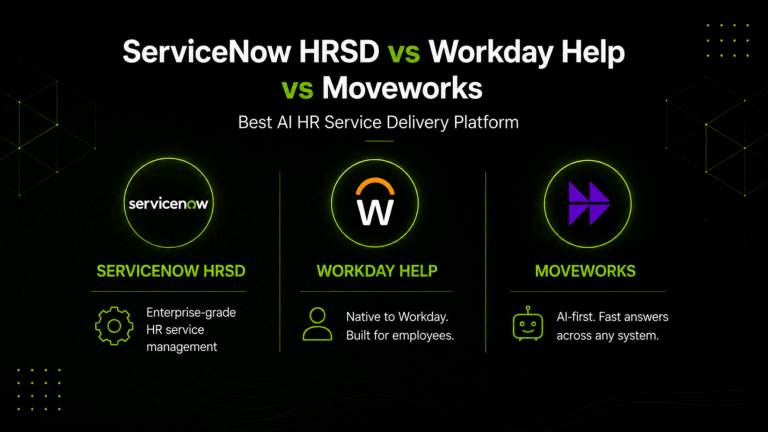
- ServiceNow HRSD’s chatbot is capable, but it’s built for IT service management organizations that also run HR , not for HR teams that want a purpose-built employee experience layer.
- The strongest alternatives are Moveworks (now part of ServiceNow), Workday Help, Leena AI, Espressive Barista, and Microsoft Copilot for HR , each with distinct strengths by stack, channel, and HR maturity.
- If your organization already runs Workday HCM, Workday Help is often the lowest-friction path. If you’re on SAP SuccessFactors, Espressive or Leena AI typically outperform native options.
- Implementation complexity is the most underestimated factor. ServiceNow HRSD can take six to twelve months to stand up properly; several alternatives deploy in weeks.
- The Moveworks acquisition by ServiceNow closes a capability gap , but also removes it as a true independent alternative going forward.
The top ServiceNow HRSD chatbot alternatives for enterprise HR teams are Moveworks (now being integrated into ServiceNow), Workday Help, Leena AI, Espressive Barista, Microsoft Copilot for HR, Applaud, and Rezolve.ai. The right choice depends on your existing HCM platform, preferred employee channels (Teams, Slack, mobile), implementation capacity, and whether you want AI-native conversation or structured case routing as your primary service model.
Why Are Enterprise HR Teams Looking for ServiceNow HRSD Chatbot Alternatives?
ServiceNow HRSD is not a bad product. At large enterprises with mature IT governance, deep ServiceNow footprints, and dedicated platform teams, it can be the right answer. The problem is that most HR buyers approach it with a wrong assumption: that being on ServiceNow already means the HR chatbot path is solved.
Running ServiceNow HRSD well requires significant configuration. The Virtual Agent (ServiceNow’s chatbot component) needs topic designers, flow designers, and NLP training before it handles real HR conversations competently. HR teams at organizations without a strong ServiceNow COE often find themselves owning a license they cannot fully operate.
There are also structural issues. ServiceNow’s heritage is ITSM , IT service management. Its data model, workflows, and UX reflect that lineage. HR teams sometimes feel like second-class citizens on the platform, dependent on IT to publish knowledge articles or modify conversation flows. That friction compounds over time.
Pricing is the third pressure point. ServiceNow HRSD is priced at the enterprise tier, and the total cost of ownership rises sharply when you add Virtual Agent licensing, integration development, and ongoing platform administration. For organizations that are not already running ServiceNow for IT, the cost-benefit case weakens considerably.
The alternatives below are evaluated on four dimensions: HR-specific depth (not just generic chatbot capability), employee channel coverage, implementation realism, and integration fit with major HCM platforms like Workday, SAP SuccessFactors, Oracle HCM, and UKG.
How Does ServiceNow HRSD’s Chatbot Actually Work?
ServiceNow HRSD’s chatbot layer runs through ServiceNow Virtual Agent, a conversational AI interface that routes employee requests to HR cases, knowledge articles, or self-service workflows within the Now Platform. It is not a standalone AI assistant , it is a front-end layer on top of HRSD’s case management and knowledge base.
The Virtual Agent uses NLP to interpret employee queries, then routes them through pre-built or custom conversation topics. Those topics can trigger case creation, return knowledge article content, or invoke workflows like leave requests or benefits enrollment. The sophistication of the response depends entirely on how well those topics are configured.
Out of the box, ServiceNow HRSD ships with pre-built HR conversation flows, but most enterprises customize heavily. Standard integrations include ServiceNow’s own HCM connectors, plus pre-built spokes for Workday, SAP SuccessFactors, and ADP via the IntegrationHub. Channel support covers Microsoft Teams, web portals, and mobile , though Teams integration requires additional configuration.
The capability is genuinely strong when the platform is tuned properly. The challenge is that “tuned properly” requires ongoing platform investment most HR teams are not staffed to provide independently.
What Did the Moveworks Acquisition Change for ServiceNow HRSD Alternatives?
ServiceNow’s announced acquisition of Moveworks , priced at $2.85 billion per ServiceNow’s official press release , changes the competitive picture in one important way: Moveworks is no longer a clean alternative to ServiceNow. It is becoming part of the ServiceNow platform under the “EmployeeWorks” branding, with the two products expected to converge over the next several product cycles.
For enterprise HR teams currently using Moveworks as a standalone layer on top of ServiceNow HRSD, the near-term answer is likely continuity. ServiceNow has stated that Moveworks capabilities will be integrated into the Now Platform, not immediately sunset. But strategic buyers should not sign a new multi-year Moveworks contract expecting it to remain an independent product.
For teams evaluating Moveworks as a ServiceNow HRSD alternative , as in, a replacement , the acquisition effectively removes it from that category. The alternatives below reflect that reality.
Which Alternatives to ServiceNow HRSD Chatbot Are Worth Evaluating?
| Vendor | Best Fit | Primary HCM Integrations | Channel Support | Deployment Speed | Pricing Model |
|---|---|---|---|---|---|
| Workday Help | Workday HCM shops | Workday (native) | Workday portal, Teams | Moderate (weeks to months) | Add-on to Workday HCM |
| Leena AI | Mid-market to enterprise, multi-HCM | Workday, SAP SF, Oracle, ADP | Teams, Slack, WhatsApp, web | Fast (4-8 weeks) | Quote-based (no public pricing page) |
| Espressive Barista | Enterprise, SAP SuccessFactors users | SAP SF, ServiceNow, Workday | Teams, Slack, web, mobile | Moderate (6-12 weeks) | Quote-based (no public pricing page) |
| Microsoft Copilot (HR use cases) | Microsoft-native organizations | Varies by connector | Teams (native), web | Fast for M365 shops | Per-user/month add-on |
| Applaud | Employee experience layer over existing HRSD | Workday, SAP SF, Oracle | Web, mobile, Teams | Moderate (8-16 weeks) | Quote-based (no public pricing page) |
| Rezolve.ai | Microsoft shops wanting IT+HR deflection | Workday, SAP, ServiceNow | Teams (native) | Fast (weeks) | Quote-based (no public pricing page) |
| Atomicwork | Mid-market, modern ITSM/HRSD together | Workday, BambooHR, others | Teams, Slack | Fast (2-4 weeks) | Quote-based (no public pricing page) |
Workday Help vs ServiceNow HRSD: Which Wins for Workday Customers?
If your organization runs Workday HCM, Workday Help is the most natural starting point for HR service delivery , not because it is universally superior, but because the integration depth is unmatched. Workday Help sits inside the Workday platform, shares the same data model, and does not require an API integration layer between the chatbot and the system of record.
Workday Help’s Knowledge Articles and Cases live natively in Workday, so when an employee asks a question through the chatbot, the system already knows their role, location, manager, benefits elections, and time-off balances. ServiceNow HRSD can achieve similar context, but only after integration configuration that requires ongoing maintenance.
The limitation of Workday Help is channel reach. Employees interact with it primarily through the Workday interface, not natively through Microsoft Teams or Slack the way Leena AI or Espressive can. Workday has been expanding its Teams integration, but it is not a frictionless experience at the time of writing. If your employees live in Teams and rarely open Workday voluntarily, Help’s adoption will lag.
For organizations weighing the broader HCM AI question, our comparison of Workday AI vs SAP Joule vs Oracle AI for HR covers how these platforms compete as full AI stacks, not just service delivery layers.
When Workday Help Beats ServiceNow HRSD
- You are already on Workday HCM and do not have a ServiceNow footprint.
- HR owns the platform relationship and does not want to depend on IT or a ServiceNow COE.
- Your employees are comfortable working inside the Workday interface.
- You want case management, knowledge, and analytics in one HCM-native environment.
When ServiceNow HRSD Beats Workday Help
- Your organization has a large, mature ServiceNow investment and a dedicated platform team.
- You need HR service delivery to work across multiple systems of record (not just Workday).
- Your IT and HR service desks are intentionally unified on one platform.
Is Leena AI a Viable Enterprise ServiceNow HRSD Alternative?
Leena AI is one of the more credible HR-native chatbot alternatives for enterprises that span multiple HCM systems. It integrates directly with Workday, SAP SuccessFactors, Oracle HCM, ADP, and several others, making it genuinely useful for organizations mid-transformation or running a multi-HRIS environment after an acquisition.
The product’s core strength is channel breadth. Leena AI deploys natively in Microsoft Teams, Slack, WhatsApp, and web portals , meaning employees can interact in whatever tool they already use. For global organizations with a distributed workforce or high deskless-worker population (where WhatsApp matters), this is a real differentiator over ServiceNow HRSD.
Leena AI positions its AI as capable of autonomous ticket resolution , not just routing. The actual automation rate varies by organization and how well the knowledge base is populated, but the architecture is designed for deflection first, escalation second. ServiceNow Virtual Agent can reach similar outcomes, but requires more configuration investment to get there.
Pricing is quote-only. Leena AI is not budget software , expect enterprise-tier pricing. Their stated deployment timeline of four to eight weeks is faster than a typical ServiceNow HRSD implementation, which matters if you are replacing an underperforming system under time pressure. Complex multi-system environments will take longer regardless of what any vendor claims.
What Does Espressive Barista Offer That ServiceNow HRSD Does Not?
Espressive Barista is an AI-native virtual agent built specifically for enterprise employee support , covering HR, IT, and facilities in one interface. Its differentiation from ServiceNow HRSD is architectural: Barista is not built on an ITSM case management platform. It is built as a language model layer that sits above existing systems of record.
This means Barista can answer HR questions by pulling context from SAP SuccessFactors, ServiceNow, and Workday simultaneously , without forcing all data to live inside ServiceNow. For enterprises that cannot or will not consolidate onto a single platform, that is a meaningful advantage. ServiceNow HRSD, by contrast, works best when ServiceNow is the system of record or the integration hub.
Espressive’s Barista LLM , their proprietary language model for enterprise search , is trained on HR, IT, and facilities content. It handles multi-turn conversations and intent disambiguation better than many out-of-the-box chatbot platforms. The trade-off is that Barista requires thoughtful knowledge base setup to perform well; the AI cannot manufacture answers from a thin content library.
Enterprise rollouts typically run six to twelve weeks based on Espressive’s published deployment methodology. Pricing is quote-based with no public pricing page. Espressive positions Barista at large enterprises (typically 5,000-plus employees), which aligns with the ServiceNow HRSD buyer profile.
Can Microsoft Copilot Replace ServiceNow HRSD for HR Service Delivery?
Microsoft Copilot is the most overhyped and most misunderstood option in this space. As a general-purpose AI assistant embedded in Microsoft 365, it can answer HR questions from SharePoint-hosted policy documents, generate content, and surface information from Teams conversations. For organizations where SharePoint is the actual knowledge base and Teams is the primary employee channel, it has real value.
What Copilot is not , yet , is an HR case management system. It cannot open, route, and resolve HR cases natively. It cannot integrate with Workday or SAP SuccessFactors to return employee-specific data (leave balances, payslips, benefits) without custom Power Platform connectors. ServiceNow HRSD handles structured HR service delivery that Copilot does not replicate out of the box.
Microsoft’s Power Virtual Agents (now part of Copilot Studio) can be configured to handle HR use cases with deeper workflow integration, but that requires development investment that blurs the line between “fast deployment” and “custom build.” Teams using Copilot Studio for HR should treat it as a development project, not a product implementation.
The right framing: Microsoft Copilot for HR is a strong complement to an HR service delivery platform, not a replacement for one , unless your HR service needs are genuinely simple and your employees already live in M365.
Is Applaud a Real Alternative or Just a UI Layer?
Applaud occupies a distinct position in this market. Rather than replacing ServiceNow HRSD, Applaud sits on top of it (and Workday, and SAP SuccessFactors) as an employee experience interface. Its argument is that the underlying systems are fine , employees just do not use them because the interfaces are poor.
Applaud builds consumer-grade employee portals and mobile apps that surface HR self-service from whatever system sits underneath. Its chatbot capability is part of this layer. For organizations that want to improve the employee experience without ripping out ServiceNow, Applaud is a legitimate option , and Applaud’s own positioning makes this case explicitly on their comparison pages against ServiceNow, Microsoft, and Workday.
The limitation is that Applaud does not fundamentally change what HR can automate. If your ServiceNow HRSD workflows are broken or underpopulated, a better front-end does not fix the underlying problem. Applaud works best when the service delivery engine is functional but the adoption is low because the UX is poor.
What About Rezolve.ai and Atomicwork for Enterprise HR Chatbot Needs?
Rezolve.ai is worth examining for Microsoft-centric enterprises that want a Teams-native HR and IT support chatbot with fast deployment. It integrates with ServiceNow (as a ticketing backend), Workday, and SAP, and runs natively inside Microsoft Teams without requiring employees to open a separate portal. The featured snippet in search results for “ServiceNow HRSD chatbot alternatives” specifically calls out Rezolve.ai as an AI-native platform in this category.
Rezolve.ai’s model is deflection-first: the chatbot attempts to resolve requests through knowledge search and workflow automation before escalating to an agent. For IT-adjacent HR queries (password resets, access provisioning, device requests), it performs well. For complex HR transactions (terminations, compensation changes, benefits disputes), it depends on how well the integrations are configured.
Atomicwork is a newer entrant targeting mid-market organizations that want IT and HR service management on a modern platform without the ServiceNow overhead. It supports Teams and Slack, and handles both ticketing and knowledge management. For organizations at the lower end of the enterprise range (500 to 3,000 employees) that find ServiceNow HRSD overbuilt and overpriced, Atomicwork is worth a demo.
How Do These Alternatives Compare on HR-Specific AI Depth?
The chatbot category has an AI marketing problem. Every vendor claims to use “AI” , but the practical question is whether the AI understands HR-specific language, respects data privacy at the employee level, and can handle transactions (not just Q&A). These are the dimensions that separate serious HR service delivery tools from rebranded IT helpdesk bots.
| Vendor | HR-Specific NLP Training | Transactional Capability (vs Q&A only) | Employee Data Privacy Handling | AI Autonomy Level |
|---|---|---|---|---|
| ServiceNow HRSD + Virtual Agent | Moderate (ITSM-rooted) | High (with configuration) | Strong (enterprise-grade) | Medium (rule + NLP hybrid) |
| Workday Help | High (HCM-native) | High (Workday transactions) | Very strong (HCM data model) | Medium |
| Leena AI | High (HR-purpose built) | High (multi-system) | Strong | High |
| Espressive Barista | High (enterprise-tuned LLM) | High | Strong | High |
| Microsoft Copilot | Low (general purpose) | Low without connectors | Moderate (M365 data governance) | Low (generative, not agentic) |
| Applaud | Moderate (UI layer) | Dependent on underlying system | Dependent on underlying system | Low to Medium |
| Rezolve.ai | Moderate (IT+HR hybrid) | Moderate | Strong | Medium |
| Atomicwork | Moderate | Moderate | Moderate | Medium |
For a broader look at how AI HR chatbots are categorized and evaluated, our coverage of the best AI HR chatbots for employee support and recruiting goes deeper on AI capability benchmarking across the full market, including vendors that do not show up in the enterprise HRSD comparison.
What Does Implementation Actually Look Like for Each Alternative?
Implementation is the most honest differentiator in this market , and the one vendors talk about least. Every vendor will tell you their product is “easy to deploy.” The real question is: easy for whom, with what team, against what existing infrastructure?
ServiceNow HRSD Implementation Reality
A full ServiceNow HRSD implementation with Virtual Agent, case management, knowledge base, and integrations to a primary HCM system typically runs six to twelve months for a large enterprise. That estimate assumes a dedicated ServiceNow platform team, an implementation partner, and HR resources to design and validate workflows. Without a strong internal ServiceNow COE, the timeline extends. If you are starting a net-new ServiceNow footprint for HR, budget for a year and a half.
For organizations navigating this complexity, resources on top HRIS implementation partners for mid-market companies and on Workday consulting firms for implementation give a realistic sense of how enterprise HR tech projects actually run , and what to look for in an implementation partner.
Alternative Implementation Timelines
- Workday Help: Four to twelve weeks for organizations already on Workday HCM. Significantly longer if starting from a knowledge base of zero.
- Leena AI: Four to eight weeks per vendor estimates for deployments where integrations to existing HCM systems are straightforward. Complex multi-system environments take longer.
- Espressive Barista: Six to twelve weeks for enterprise deployments based on Espressive’s published onboarding methodology, which requires HR content development in parallel.
- Microsoft Copilot: Days to weeks for basic M365 activation, but weeks to months for HR-specific Power Platform connector builds.
- Rezolve.ai: Two to four weeks for Teams-native deployments with standard integrations, based on their published deployment model.
- Atomicwork: Two to four weeks for mid-market organizations, per their stated deployment model.
What Should Enterprise HR Teams Ask Before Choosing a ServiceNow HRSD Alternative?
The vendor selection process for HR service delivery platforms is where good intentions go to die. Most RFPs focus on feature lists; the decisions that actually determine success are made elsewhere. These are the questions that separate useful evaluation from theater.
- What is our system of record, and does this platform treat it as first-class? A chatbot that has to reverse-engineer Workday data through an API is always one data model change away from breaking.
- Who owns this platform after go-live , HR, IT, or a shared team? ServiceNow HRSD typically lands with IT. Workday Help lands with HR. Leena AI and Espressive can go either way. Get this clear before you sign.
- What does the knowledge base look like in six months if nothing is maintained? AI chatbots degrade without content governance. Ask each vendor for their content health reporting capabilities.
- What are the escalation paths, and who handles Level 2 cases? Chatbots handle deflection. Humans handle exceptions. The integration between AI and human agents determines whether employees trust the system.
- What is the total cost of ownership, not just the license? Include integration development, ongoing administration, content management, and the cost of the internal team or consulting partner that will keep it running.
For a more comprehensive set of due-diligence questions across HR technology categories, the AI HR vendor evaluation checklist for CHROs covers fifty questions worth asking before committing to any AI-powered HR platform.
How Do AI Agents Change the ServiceNow HRSD Chatbot Comparison?
The category is shifting faster than most enterprise procurement cycles can track. The next generation of HR service delivery is not chatbots , it is agentic AI that can take actions across systems autonomously, not just answer questions or open cases. The distinction matters for any vendor decision you make in the next twelve months.
ServiceNow is investing in agentic AI through its Now Assist platform, with HR use cases included. Workday has announced agentic capabilities in its HCM roadmap. Leena AI and Espressive both position their platforms as moving toward autonomous HR action, not just conversational Q&A. Microsoft Copilot’s agentic layer (via Copilot Agents) is the least HR-specific but the most integrated with M365 workflows.
If you are evaluating a five-year platform, the chatbot you buy today is the infrastructure your AI agent runs on in three years. That shifts the evaluation from “which chatbot is best” to “which platform has the HR data model, integration depth, and AI roadmap to support autonomous action.” Workday and ServiceNow have the infrastructure advantage. Purpose-built players like Leena AI and Espressive have the HR specificity advantage. The gap is closing from both directions.
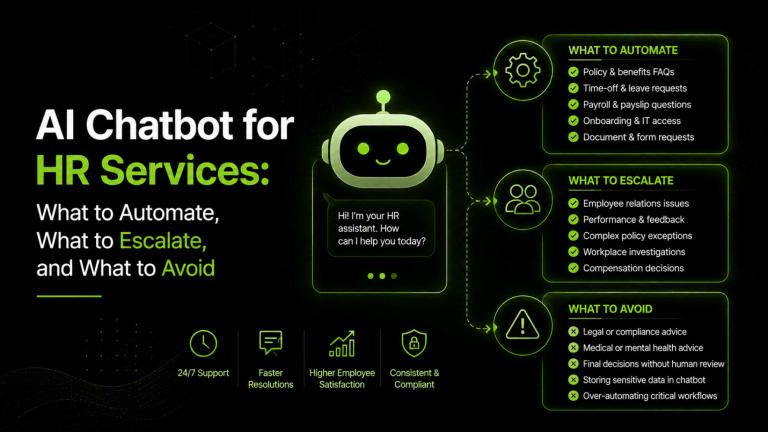
For a grounded explanation of what AI agents actually do in HR service delivery , and where autonomy has limits , our piece on what AI agents can automate in HR service delivery is worth reading before you finalize a vendor shortlist.
Which ServiceNow HRSD Chatbot Alternative Is Right for Your Organization?
This is not a category where one platform wins across all scenarios. The decision tree is relatively clean once you establish a few facts about your environment.
| Your Situation | Best Alternative | Why |
|---|---|---|
| Already on Workday HCM, no ServiceNow | Workday Help | Native integration, HCM data in chatbot context, HR-owned platform |
| SAP SuccessFactors primary HCM | Espressive Barista or Leena AI | Strong SAP SF integrations, HR-native NLP |
| Microsoft M365 shop, simple HR service needs | Rezolve.ai or Microsoft Copilot Studio | Teams-native, fast deployment, lower admin overhead |
| Multi-HCM environment (post-acquisition) | Leena AI | Broadest multi-HCM integration without ServiceNow dependency |
| ServiceNow HRSD in place, poor employee adoption | Applaud | Improves UX without replacing the underlying service delivery engine |
| Mid-market, want ITSM + HRSD without ServiceNow cost | Atomicwork | Modern platform, fast deployment, lower total cost |
| Large enterprise, strong ServiceNow COE, IT+HR unified | Stay on ServiceNow HRSD | Platform maturity, integration depth, agentic roadmap justify the investment |
Frequently Asked Questions
What are the main ServiceNow HRSD chatbot alternatives for enterprise HR teams?
The primary alternatives are Workday Help (for Workday HCM shops), Leena AI (for multi-HCM environments), Espressive Barista (for SAP SuccessFactors-heavy organizations), Microsoft Copilot with Power Platform connectors (for Microsoft-native environments), Applaud (as a UX layer over existing platforms), Rezolve.ai (for Teams-native IT and HR deflection), and Atomicwork (for mid-market organizations wanting a modern alternative to ServiceNow’s overhead). Moveworks was previously a strong independent option but has been acquired by ServiceNow and is being integrated into the Now Platform.
How does Workday Help compare to ServiceNow HRSD for HR service delivery?
Workday Help has a significant advantage for organizations already running Workday HCM: it shares the same data model, so the chatbot has native access to employee records, time-off balances, and benefits data without API integration work. ServiceNow HRSD is more powerful for organizations that need to unify IT and HR service delivery on one platform or that have complex multi-system environments. Workday Help’s weakness is channel reach , it lives primarily in the Workday interface, not natively in Teams or Slack the way competitors do.
Is Leena AI a credible enterprise-grade HR chatbot?
Yes, with caveats. Leena AI integrates with the major HCM platforms (Workday, SAP SuccessFactors, Oracle HCM, ADP) and deploys natively in Teams, Slack, and WhatsApp, which gives it better channel coverage than most competitors. Its AI is purpose-built for HR, not adapted from an IT service management platform. The main caveats are that pricing is enterprise-tier (quote-only), the system depends heavily on a well-maintained knowledge base to perform, and it requires real integration work to connect to your systems of record.
What happened to Moveworks and can it still replace ServiceNow HRSD?
Moveworks was acquired by ServiceNow in 2025, which changes the competitive picture considerably. Rather than being an alternative to ServiceNow HRSD, Moveworks is now being absorbed into the ServiceNow platform, with its conversational AI capabilities folded into ServiceNow’s broader product roadmap. Organizations that were evaluating Moveworks as a standalone alternative should treat it as a ServiceNow bet at this point, not an independent option.
How long does implementation actually take for these platforms compared to ServiceNow HRSD?
ServiceNow HRSD implementations at enterprise scale typically run six to twelve months when you factor in knowledge base migration, workflow configuration, and integration work, so the comparison baseline is not a fast one. Leena AI and Microsoft Copilot for HR tend to reach basic productivity in eight to twelve weeks if your HCM data is clean and your Teams or Slack deployment is already standardized, but that timeline assumes you have someone internally who owns the knowledge base and can make decisions about workflow scope. Workday Help is the fastest to deploy for Workday shops, sometimes four to six weeks for core Q&A functionality, but that speed only holds if you are not trying to connect it to systems outside Workday.
How do you figure out which HR chatbot actually fits your existing tech stack?
Start with where your employees already spend time: if your organization runs on Microsoft 365 and Teams is the primary collaboration tool, Microsoft Copilot for HR or a Teams-native deployment of Leena AI will see far higher adoption than a portal-based tool that requires employees to go somewhere new. Then look at where your authoritative HR data lives: if it is all in Workday, Workday Help has a real advantage; if you are running SAP SuccessFactors or a split environment, you need a platform with documented, maintained connectors to those systems, not just a promise of API flexibility. The final filter is your IT service management layer, because if HR and IT tickets share a platform today, replacing only the HR side creates fragmentation that will frustrate both teams.
Should HR teams evaluate these tools separately from IT, or jointly?
Jointly, almost always. The platforms that perform best for HR, including ServiceNow HRSD and Microsoft Copilot, are the same platforms IT is already evaluating for service desk automation, and buying them separately means paying twice and managing two integrations for what could be a shared knowledge layer. The practical exception is if HR has a strong, funded mandate to move faster than IT is willing to, in which case a purpose-built HR tool like Leena AI lets HR ship without waiting for an IT procurement cycle. But that decision should be made consciously, not by default.