
TLDR
- On Sept. 21, 2026, Rippling announced the Rippling AI Lab at its Embassy Tech Village campus in Bengaluru, the company’s largest engineering hub outside San Francisco.
- The Lab will own core AI platform work: infrastructure, evaluation frameworks, sandboxing, scaling, latency optimization, and related capabilities that power AI across Rippling products.
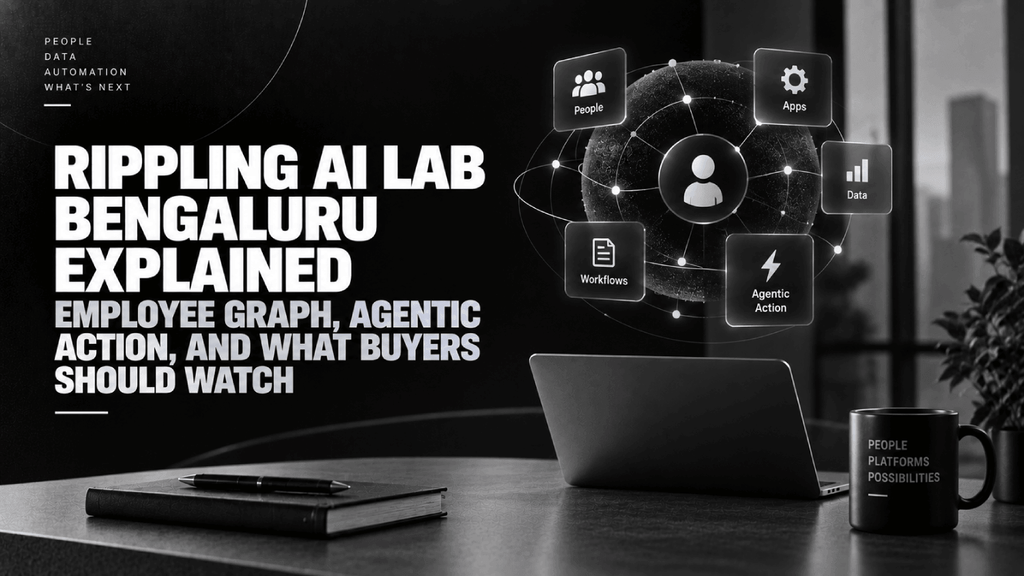
- Rippling’s pitch for why this matters is the Employee Graph: a live model of identity, reporting structure, governance, permissions, and policy that every native product shares, so AI can act inside existing controls and audit trails.
- India footprint: nearly 2,500 employees since 2017, workspace expanding to 170,000 sq ft at Embassy Tech Village, with plans to grow headcount; hiring across AI research, applied AI, backend, platform, ML, and engineering leadership.
- For buyers: this is an investment signal about agentic HR/IT/Finance action on a unified data model, not a new SKU. Ask what writes back today, how permissions and audits work, and how sandboxing bounds autonomous workflows before treating Lab news as a product promise.
Rippling published a Business Wire release on Sept. 21, 2026 (carried Sept. 22 on financial wires) launching the Rippling AI Lab in Bengaluru. The company positions itself as an AI-native workforce platform spanning HR, IT, and Finance, and frames the Lab as the research and engineering group that will keep that AI layer improving in production.
That is useful for HrTechSaas readers because mid-market and growth buyers already compare Rippling on unification (HR plus IT plus payroll). The news is not another “AI chatbot in HR” announcement. It is a concrete bet that platform AI (eval, sandboxing, latency, permissions-aware action) will decide who can safely automate workflows that touch pay, access, and devices.
This piece stays on Rippling’s Lab announcement, Employee Graph framing, and buyer questions. It is not a rewrite of Rippling alternatives or HRIS comparison listicles already on the site.
What Rippling announced
Per the Sept. 21 Business Wire release (via FinancialContent):
- The Rippling AI Lab is a research and engineering group dedicated to continuous AI innovation.
- It is based at Rippling’s Embassy Tech Village campus in Bengaluru.
- The Lab develops core components of Rippling’s AI platform, including infrastructure, evaluation frameworks, sandboxing, scaling, latency optimization, and other platform capabilities that support AI across products.
- Rippling is hiring for AI research, applied AI, backend engineering, platform engineering, and machine learning, with roles from senior engineer through principal engineer and engineering leadership (open roles listed at rippling.com/careers).
Sonia Parandekar, Rippling’s Senior Vice President of Engineering and India Site Lead, said: “Our goal has been to build an engineering organization in India with ownership of some of Rippling’s most important technical challenges. The AI Lab is a natural next step, giving engineers here the opportunity to solve ambitious technical problems and build AI products that will have an impact for customers around the world.”
Why Employee Graph is the real product story
Rippling’s release spends as much time on architecture as on the Lab itself. The company says the Employee Graph is a live model of identity, reporting structure, governance, permissions, and policy across an organization. Payroll, finance, benefits, compliance, and IT management were built natively on that shared model rather than stitched from acquired point solutions.
The buyer-facing claim that follows is blunt: because every product shares the same underlying data model, AI can pull accurate, real-time context about people, finances, and policies, and take action within each customer’s existing permissions and audit trail.
Rippling’s worked example is international onboarding. Rather than only suggesting how to onboard an employee in a new country, Rippling AI can run the process itself: apply applicable tax rules, provision account access, ship devices, enroll benefits, and route approvals through the right stakeholders, all inside existing controls and audit trails.
Treat that example as a capability direction, not a checklist of every jurisdiction or workflow available on day one. Ask which countries, modules, and write-back actions are live in your tenant before you budget for agentic onboarding.
India investment context buyers can verify
The Lab sits inside a larger India engineering story Rippling put in the same release:
| Claim (vendor-reported) | Detail |
|---|---|
| India operations started | 2017 |
| India headcount | Nearly 2,500 employees, with plans to increase |
| Bengaluru footprint | Embassy Tech Village expansion to 170,000 sq ft total workspace |
| Funding context (About Rippling) | Raised $1.8B (Kleiner Perkins, Founders Fund, Sequoia, Bedrock, among others) |
None of those figures prove product quality on their own. They do signal where Rippling intends to put AI platform ownership: not only in San Francisco product marketing, but in a scaled engineering hub building eval, sandboxing, and latency work that production agents need.
How this differs from existing HrTechSaas coverage
The site already covers adjacent buying jobs:
- 10 Best Rippling Alternatives for HR, Payroll & IT
- Rippling vs Deel vs Remote
- Workday vs Rippling vs BambooHR
- Gusto vs Rippling vs Justworks
Those pages help buyers shortlist platforms and price-fit. This draft is different:
- News explainer on the Rippling AI Lab (Sept. 21, 2026)
- Focus on AI platform investment, Employee Graph, and agentic action with permissions
- Not a multi-vendor alternatives listicle and not a stage-based HRIS comparison
Do not merge this into the Rippling alternatives or vs-Deel URLs. Different intent, different publish job.
It is also distinct from recent hub drafts on UKG Agentic Pay, ADP Assist/AWS, Workday’s Gartner WFM Magic Quadrant, and Workable recruiting agents. Those pieces cover other vendors’ GA or analyst moments. This one is Rippling’s Bengaluru Lab plus the unified-data argument for trusted AI action.
Who should care, and what to ask
Prioritize a read-out if you:
- Are shortlisting Rippling for unified HR, payroll, and IT and want a signal on how serious the AI roadmap is
- Care more about permissioned write-back and audit trails than chatbot demos
- Are comparing “AI-native” mid-market platforms against enterprise HCM stacks that add agents on top of older data models
Ask Rippling (and your security/compliance partner):
- Which Employee Graph–backed workflows can AI execute today versus recommend only?
- How are sandboxing and evaluation frameworks exposed to customers (or only used internally)?
- What audit trail exists for AI-initiated provisioning, payroll setup, benefits enrollment, and approval routing?
- How do role permissions constrain what Rippling AI can change in IT Cloud versus HR versus Finance modules?
- For multi-country onboarding, which tax, entity, and device workflows are live in your footprint?
- How does Lab-built infrastructure change latency and reliability SLOs for AI actions your admins will trust in production?
The take: Lab news is a platform bet, not a feature list
Rippling’s Sept. 21 AI Lab announcement is concrete investment news: a named Bengaluru research and engineering group, clear ownership of AI platform plumbing, and an explicit Employee Graph story for why agents can act inside permissions instead of beside them.
For operators, the durable question is whether that architecture delivers auditable, permission-safe action across HR, IT, and Finance faster than competitors who bolt agents onto fragmented systems. Headcount and square footage are supporting evidence of commitment. They are not a substitute for a scoped pilot with write-back logs, sandbox rules, and clear human approval gates.
If you already run Rippling, use the Lab news as a reason to ask for a current map of AI actions that write to production objects, then pilot one high-volume workflow (onboarding or access provisioning) with weekly audit review. If you are still evaluating against Deel, Remote, Workday, or BambooHR paths covered on the site, keep the Lab announcement in the “platform seriousness” column, not as a reason to skip a module-by-module quote and implementation plan.
FAQ
When did Rippling announce the AI Lab?
Rippling’s Business Wire release is dated Sept. 21, 2026 (widely carried on Sept. 22, 2026).
Where is the Rippling AI Lab based?
At Rippling’s Embassy Tech Village campus in Bengaluru, described as the company’s largest engineering hub outside San Francisco.
What will the Lab work on?
Core AI platform components: infrastructure, evaluation frameworks, sandboxing, scaling, latency optimization, and related capabilities that support AI across Rippling products.
What is the Employee Graph?
Rippling’s term for a live model of identity, reporting structure, governance, permissions, and policy shared across its native HR, IT, payroll, finance, benefits, and compliance products.
How large is Rippling’s India organization?
Rippling reports nearly 2,500 employees in India, operations since 2017, and an Embassy Tech Village expansion to 170,000 sq ft of workspace, with plans to grow headcount.
Is this a new Rippling product SKU?
No. The announcement is an R&D and engineering investment plus hiring signal. Treat any agentic workflow claims as items to verify in your tenant and contract, not as a named SKU launch.
How is this different from Rippling alternatives articles?
Alternatives and vs-pages help you choose a platform. This draft explains one current news event: the Bengaluru AI Lab and why Rippling says unified data plus permissions matter for AI action.