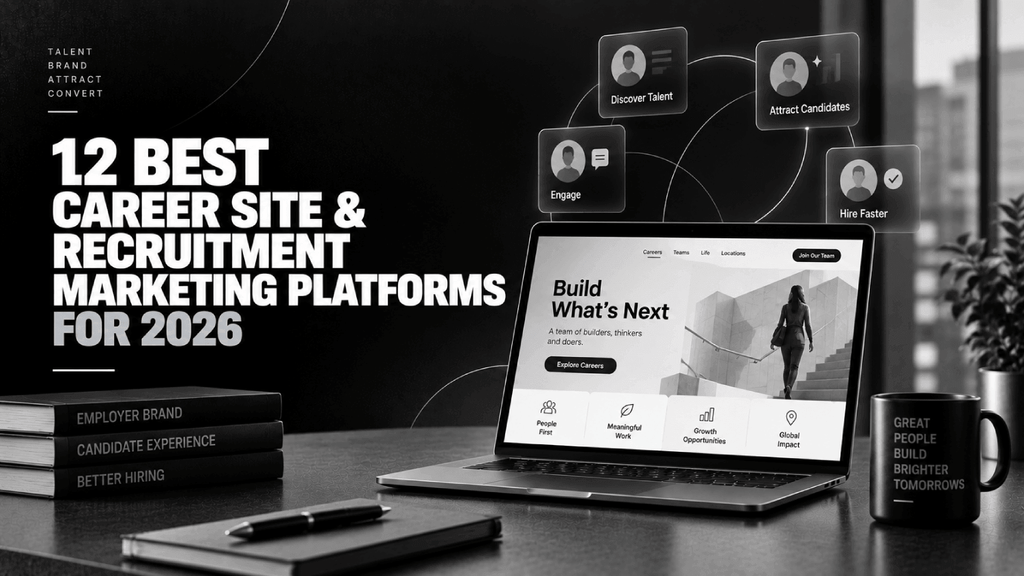

- Your ATS careers page was built to collect applications, not to convert candidates. Adding a recruitment marketing platform on top of it typically lifts apply rates by addressing the friction your ATS cannot touch: slow load times, generic job descriptions, no nurture path for silver-medal candidates.
- The core capability set you need is: branded career site, talent CRM for candidate nurture, programmatic job advertising with source of hire attribution, and landing page personalization. Most ATS vendors offer one or two of these. Dedicated platforms offer all four.
- Platforms in this list fall into three tiers: full-suite recruitment marketing (SmashFly/Symphony Talent, Beamery, Clinch, Phenom), career site specialists (Teamtailor, Recruitee, Compology), and programmatic-first tools (Appcast, Joveo, PandoLogic).
- The biggest evaluation mistake is picking on brand fit rather than ATS integration depth. A beautiful career site that cannot write back application data into Workday or Greenhouse doubles recruiter work.
- Before finalizing any shortlist, read our breakdown of recruitment command center platforms for context on how the marketing layer connects to the broader talent acquisition stack.
A recruitment marketing platform is software that sits between your employer brand and your ATS, giving talent teams a branded career site, a candidate CRM, programmatic job distribution, and conversion analytics. The best platforms in this category let recruiters build talent pipelines before roles open, personalize job content by candidate segment, and attribute hires to their actual source rather than “careers site” as a catch-all.
Why Your ATS Careers Page Is Costing You Candidates
ATS-native career pages are designed by compliance and engineering teams, not by conversion rate specialists. They render slowly on mobile, present every role in the same format regardless of audience, and drop candidates who are not ready to apply today with no way to stay in contact. That last point is where the most damage happens.
Recruitment marketing platforms solve a different problem than an ATS. The ATS manages candidates who have applied. A recruitment marketing platform manages candidates who might apply, building a talent pipeline that reduces time-to-fill on future requisitions and cuts dependence on paid job boards. These are distinct workflows, and conflating them is why teams end up paying for Indeed sponsored listings every quarter rather than converting their existing talent pool.
The apply conversion gap between ATS career pages and dedicated career sites is consistently reported by practitioners who have rebuilt career sites on dedicated platforms. Common improvements include faster page loads, schema-optimized job postings for Google for Jobs indexing, segmented landing pages by persona, and an “express interest” path for passive candidates. None of that ships with a standard ATS.
What Separates a Recruitment Marketing Platform From an ATS Bolt-On?
Four capabilities define the category. A platform must do all four to qualify.
- Branded career site with landing page personalization: Dynamic content that changes based on the candidate’s source, location, or job family. Not just a logo swap.
- Talent CRM and candidate nurture: Email and SMS sequences for silver-medal candidates, event registrants, and passive talent. Think drip campaigns, not just application status updates.
- Programmatic job advertising: Automated distribution of job postings across job boards with real-time budget reallocation based on performance. Not just posting to five boards simultaneously.
- Source of hire attribution: The ability to track which channel produced a hire, not just which channel produced a click. This requires ATS integration, not just pixel tracking.
Platforms that only do two or three of these are not recruitment marketing platforms. They are career site builders or job distribution tools. That distinction matters at the buying stage.
The 12 Best Recruitment Marketing Platforms: Who They Are For
| Platform | Best For | Key Strength | Pricing Model |
|---|---|---|---|
| Clinch | Enterprise TA teams on SmartRecruiters or Jobvite | Deep ATS integration, personalized job landing pages | Quote-based |
| Teamtailor | Mid-market, EU-first companies | Career site UX, built-in ATS, GDPR tooling | Per-user, publicly listed |
| Appcast | High-volume, programmatic-first buyers | Programmatic job advertising, CPC optimization | % of media spend |
| Joveo | Staffing firms and high-volume enterprise | Programmatic reach across 500+ publishers | Quote-based |
| PandoLogic | Retail, healthcare, hourly hiring | AI-driven programmatic, Pandologic Apploi integration | Quote-based |
| Symphony Talent (SmashFly) | Enterprise with a mature employer brand function | Full-suite CRM plus career site plus analytics | Quote-based |
| Beamery | Enterprise running skills-based hiring strategies | Talent graph, CRM, candidate nurture at scale | Quote-based |
| Recruitee | Scaleups under 500 employees | Career site + ATS in one, fast setup | Per-job, publicly listed |
| Phenom | Enterprise, internal mobility plus external TA | AI-powered experience across candidate and employee touchpoints | Quote-based |
| Radancy | Enterprise with heavy media buying requirements | Unified talent acquisition cloud, analytics | Quote-based |
| SmartRecruiters Marketing Edition | Companies already on SmartRecruiters ATS | Native integration, no data latency | Add-on to SmartRecruiters contract |
| Gem | Tech companies focused on sourcing and talent pipeline | Sourcing automation plus CRM plus analytics | Quote-based |
Which Platforms Handle Programmatic Job Advertising and Candidate Nurture Together?
Most platforms do one well and fake the other. Here is where each actually stands.
Appcast
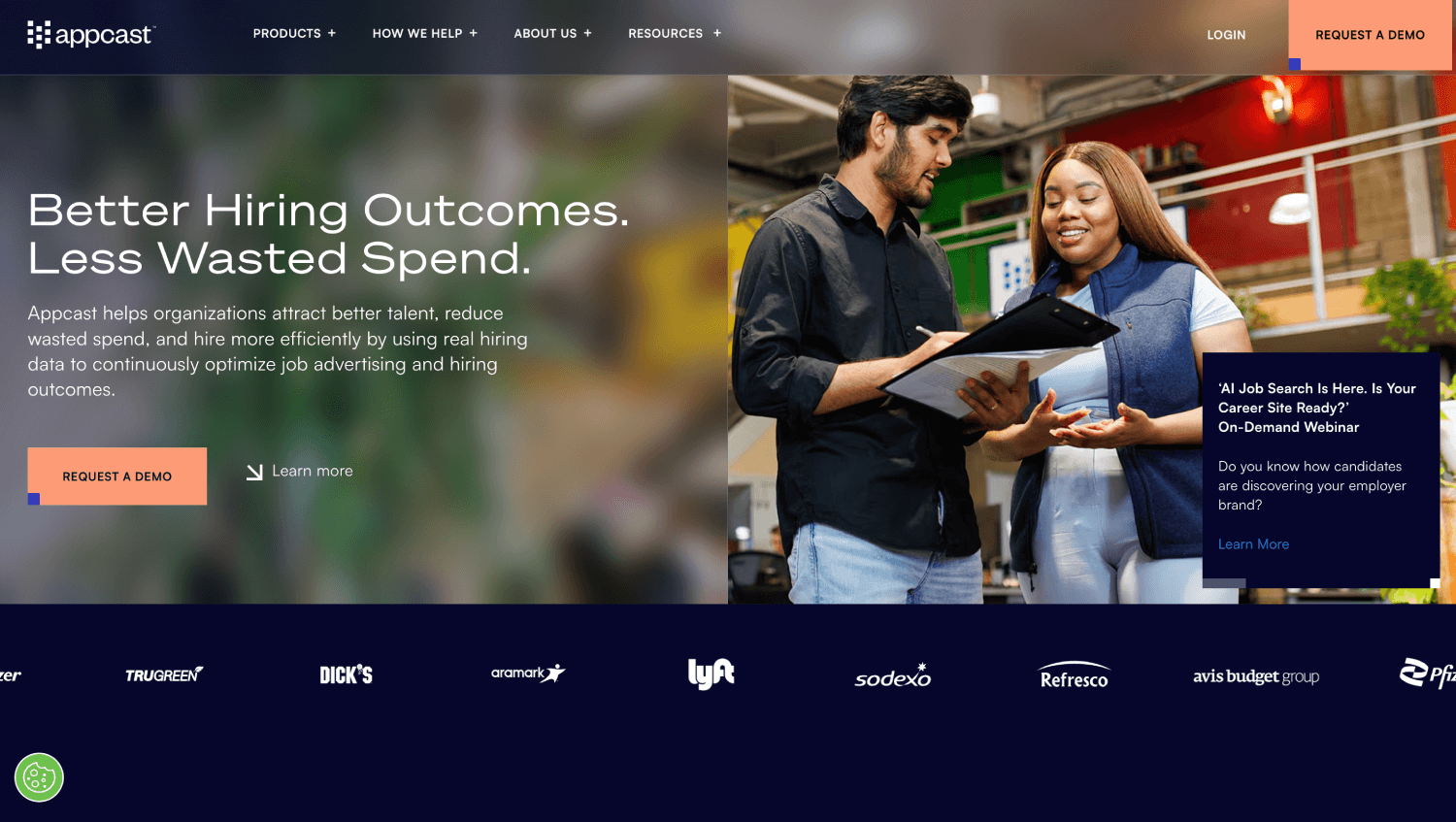
Appcast is the most widely deployed programmatic job advertising tool in North America. Its core capability is distributing job postings across a network of job boards and optimizing spend in real time based on cost per applicant, not cost per click. It does not have a native candidate CRM, so teams that want nurture sequences need to connect it to a separate tool such as Beamery or Gem. Appcast charges a percentage of media spend, making it scale naturally with hiring volume.
Joveo
Joveo covers programmatic distribution across over 500 publishers, with stronger international reach than Appcast. Its MOJO platform includes source of hire attribution and real-time budget management. Like Appcast, candidate nurture is not a native feature. Joveo fits staffing firms and enterprise teams with large requisition volumes across multiple geographies.
PandoLogic
PandoLogic runs AI-driven programmatic advertising with a specific focus on high-volume roles in retail, healthcare, and logistics. Its acquisition of Apploi strengthened its position in healthcare hourly hiring. PandoLogic handles job distribution and apply conversion but not full candidate nurture. Teams hiring for exempt professional roles will find its sweet spot narrow.
Symphony Talent (SmashFly)
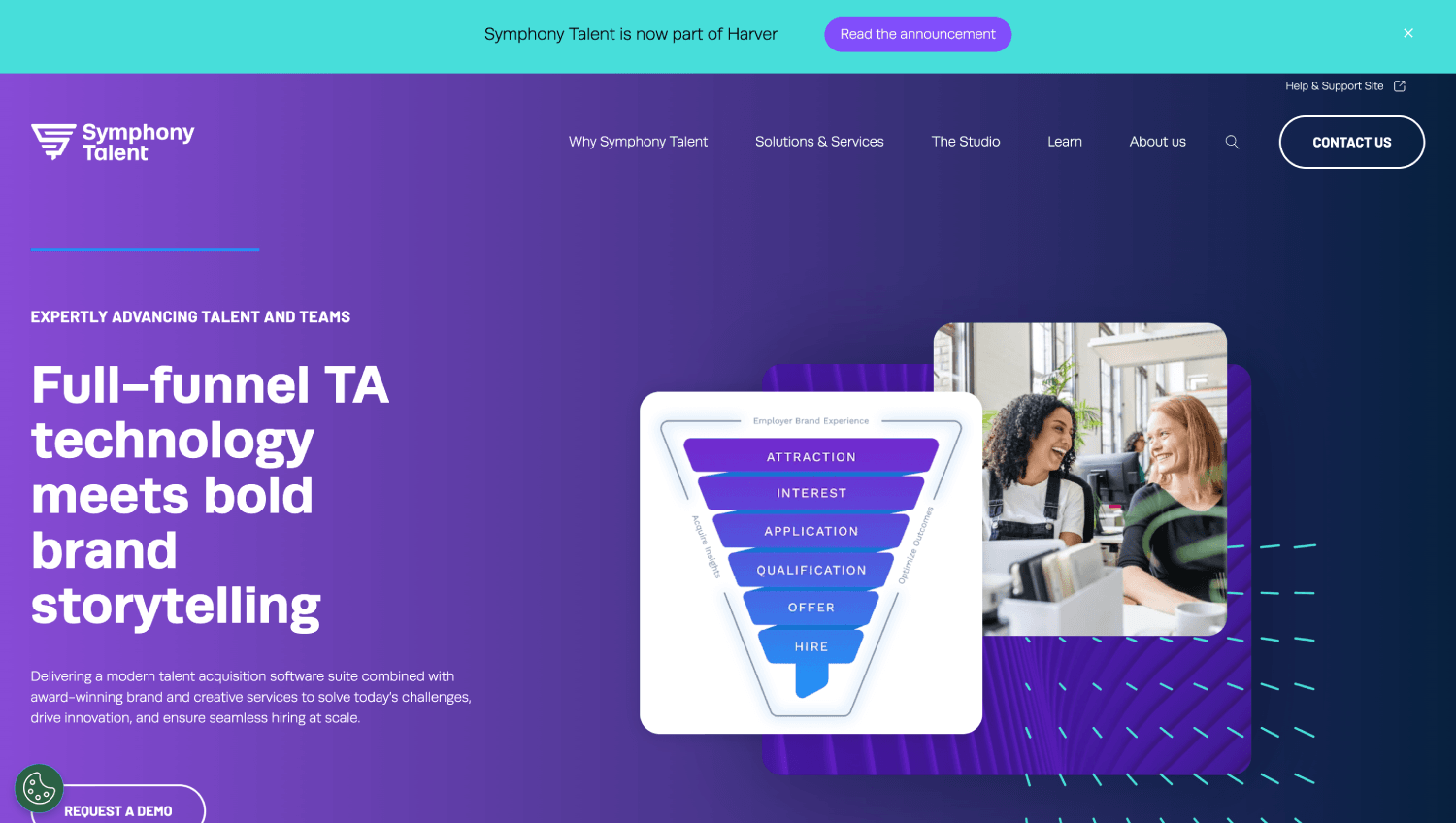
Symphony Talent, which absorbed the original SmashFly brand, is one of the few platforms that genuinely combines programmatic distribution with a full talent CRM and career site. It is built for enterprise TA teams that have a dedicated employer brand function and a recruitment marketing budget north of what mid-market teams typically operate with. Implementation is not quick and the platform has a learning curve, but the analytics layer is genuinely strong for source of hire attribution across paid and organic channels.
Beamery
Beamery is the strongest talent CRM and candidate nurture platform in this list. Its talent graph maps candidates to skills and roles over time, which matters if you are running a skills-based hiring strategy. Programmatic job advertising is not Beamery’s native strength. Teams pair it with Appcast or Joveo for distribution and use Beamery purely for CRM, nurture, and talent pipeline. We covered Beamery in more depth in our talent intelligence platform comparison.
Which Career Site Platforms Give the Best Apply Conversion Rate?
Apply conversion rate is the ratio of career site visitors to completed applications. Most ATS career pages convert at low single-digit percentages. Dedicated career site platforms target improvements through faster load times, mobile-first application flows, and personalized job content.
Clinch
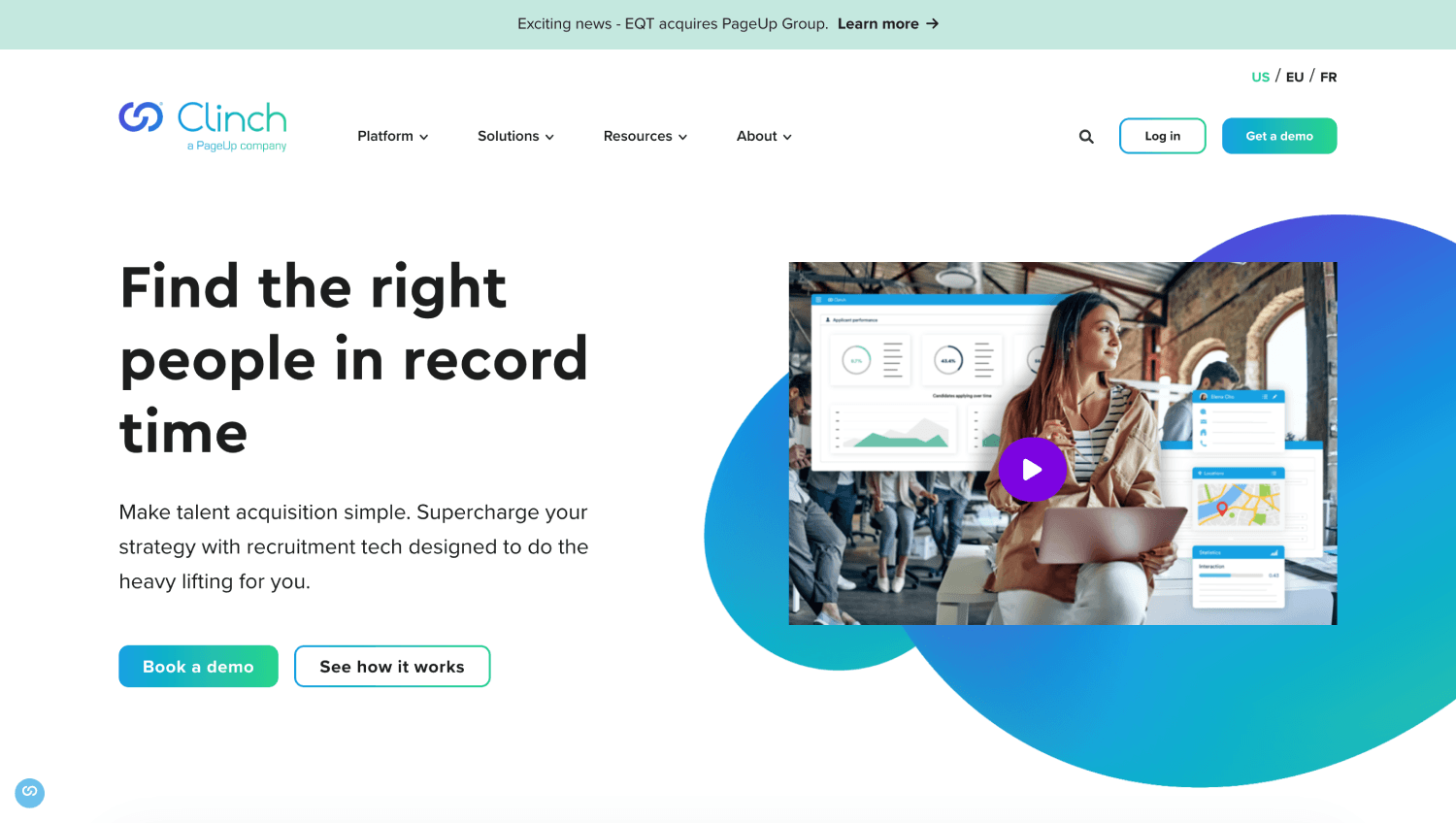
Clinch, now part of PageUp Group, builds career sites with landing page personalization at the job and audience level. A candidate arriving from a LinkedIn ad for an engineering role sees different content than one arriving organically for a sales role. Its ATS integration is deep, particularly with SmartRecruiters and Jobvite, and application data flows back without recruiter re-entry. For enterprise TA teams who already have an ATS and want to bolt a conversion-focused career site on top, Clinch is the strongest candidate.
Teamtailor
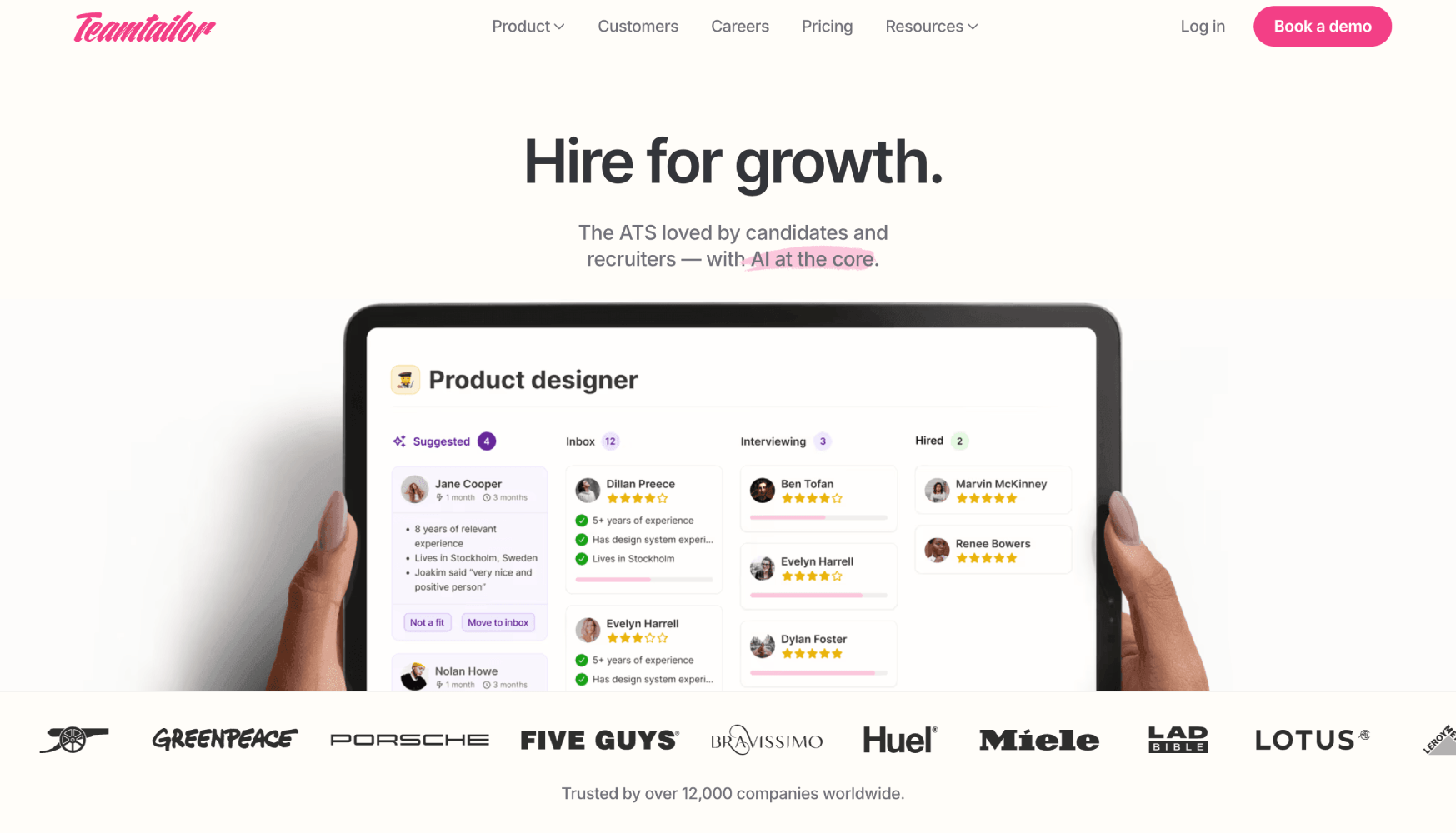
Teamtailor combines a career site builder with a lightweight ATS. Its pricing is publicly listed, it is GDPR-native, and its career site templates are genuinely well-designed for mobile. For mid-market companies in Europe that need both a career site and an ATS without paying enterprise rates, Teamtailor is the most complete single-vendor answer. The built-in ATS handles the core hiring workflow for most companies under 500 employees, though teams with complex enterprise requirements will need to supplement it or move to a dedicated ATS.
Recruitee
Recruitee operates in a similar space to Teamtailor, combining a career site with ATS functionality at a per-job pricing model. It is faster to set up than Teamtailor and the career site is cleaner for small hiring volumes. Candidate nurture is limited. For founders and ops leads building an HR stack from scratch, Recruitee gets a team live in days rather than weeks. Pair it with a tool like Gem for sourcing if hiring volume grows.
How Does Gem Fit Into a Recruitment Marketing Stack?
Gem is primarily a sourcing and talent pipeline tool, but its CRM functionality is strong enough that many tech-company recruiting teams use it as their entire candidate nurture layer. Gem integrates with Greenhouse, Lever, Workday Recruiting, and iCIMS to sync candidate data and source of hire attribution back to the ATS. It does not build career sites or run programmatic advertising. Tech teams that source heavily from LinkedIn and GitHub find Gem’s Chrome extension and automated outreach sequences genuinely useful. For a fuller picture of AI sourcing tools that complement Gem, see our review of the best AI sourcing tools and LinkedIn Recruiter alternatives.
What Is the Difference Between a Recruitment Marketing Platform and an ATS Careers Page?
An ATS careers page lists open roles and collects applications. It is transactional and compliant. A recruitment marketing platform is designed to attract, engage, and convert candidates, including those who are not ready to apply today. The practical differences are significant.
| Capability | ATS Careers Page | Recruitment Marketing Platform |
|---|---|---|
| Branded career site design | Template only | Custom, fully branded |
| Landing page personalization | None | By source, role, or persona |
| Candidate CRM / nurture | None | Email, SMS drip sequences |
| Programmatic job distribution | Manual board posting | Automated, budget-optimized |
| Google for Jobs SEO | Partial (schema inconsistent) | Full schema markup, auto-updated |
| Source of hire attribution | Last-click only | Multi-touch, media-level |
| Passive candidate pipeline | Not possible | Core feature |
How Much Do Recruitment Marketing Platforms Cost?
Pricing in this category is mostly quote-based, with a few exceptions. Teamtailor and Recruitee both publish pricing on their websites and are the most accessible options for teams with a defined budget. Symphony Talent, Beamery, Clinch, Phenom, and Radancy are all enterprise contracts without public pricing, typically running to five or six figures annually depending on company size and module selection.
Programmatic platforms like Appcast charge a percentage of media spend, so cost scales directly with hiring volume. A team spending $50,000 per year on job board advertising might pay Appcast a management fee on top of that media spend. Joveo and PandoLogic operate similarly. Budget for both the platform fee and the media spend when modeling total cost.
For any platform requiring a custom quote, use our HR software buying checklist to structure the procurement conversation and avoid the most common hidden cost surprises.
How Do Recruitment Marketing Platforms Handle SEO for Job Pages?
Google for Jobs indexes job postings that carry structured data markup (schema.org/JobPosting). ATS career pages often generate this markup inconsistently, with stale close dates or missing salary data that causes Google to deprioritize the listings. Dedicated recruitment marketing platforms manage this schema automatically, update job postings in real time, and often include canonical URL management so duplicate job postings across multiple sites do not dilute page authority.
Clinch and Symphony Talent both include technical SEO tooling for job pages as part of their career site offering. Teamtailor generates structured data automatically and has built-in tools for adding meta descriptions at the job level. If organic candidate traffic matters to your strategy, the SEO gap between an ATS career page and a dedicated career site is meaningful.
Which Recruitment Marketing Platform Is Best for Enterprise Talent Acquisition Teams?
For large enterprise teams with a dedicated employer brand budget, a recruitment marketing agency relationship, and complex ATS integrations, the shortlist is Phenom, Radancy, Symphony Talent, Beamery, and Clinch. Each serves the enterprise buyer but with different primary strengths.
Phenom positions itself as a full talent experience platform, covering candidates, employees, and managers. Its AI features for job recommendations and candidate matching are genuinely built in rather than bolted on. Radancy’s strength is media buying and analytics, particularly for companies that run large programmatic advertising campaigns. Symphony Talent is the choice for teams that want a single vendor for CRM, career site, and programmatic in one contract. Beamery fits enterprises running skills-based hiring where the talent graph matters more than the career site design.
For teams evaluating AI features specifically, review our analysis of the best AI HR chatbots for recruiting, since several recruitment marketing platforms now include conversational AI for candidate engagement as part of their career site stack.
SmartRecruiters Marketing Edition and the Native Integration Advantage
SmartRecruiters Marketing Edition is worth considering specifically if your ATS is SmartRecruiters. The native integration means no data latency between apply events and recruiter pipelines, no middleware to maintain, and no re-keying. If you are on any other ATS, the integration work required largely cancels out the benefit. This is true of most ATS-native marketing add-ons. Evaluate them only if the ATS fit is confirmed first.
How to Choose: A Practical Decision Framework
Start with the four core capabilities and rank which gap hurts most today. If your apply rates are low and your career site is the problem, prioritize career site and landing page personalization. If you have high career site traffic but lose silver-medal candidates and never re-engage them, a talent CRM should lead. If you are spending on Indeed and LinkedIn without knowing which spend produces hires, programmatic with source attribution should come first.
Second, check ATS integration depth before any demo. Ask the vendor specifically whether their integration supports bi-directional data sync, whether application data writes back to your ATS in real time, and whether source of hire attribution shows in your ATS reporting. A vendor who cannot answer these questions concretely will not deliver attribution after you sign.
Third, factor implementation. Recruitment marketing platforms are not plug-and-play. A career site rebuild typically takes 60 to 120 days. CRM setup requires agreement on nurture workflows and segmentation logic before any email goes out. For teams without an employer brand specialist in-house, plan for a consulting engagement alongside the software. Our ATS implementation consultants guide covers implementation partners who also handle adjacent recruitment marketing setup.
For enterprise teams evaluating the full talent acquisition stack rather than just the marketing layer, the recruitment command center platforms overview covers how recruitment marketing, ATS, analytics, and sourcing connect at the architecture level.
Frequently Asked Questions
Do I need a recruitment marketing platform if I already use LinkedIn and Indeed?
Paying for LinkedIn Recruiter and Indeed sponsored listings does not replace a recruitment marketing platform. Those tools generate candidate traffic. A recruitment marketing platform converts that traffic, nurtures candidates who do not apply immediately, and tells you which spend produced actual hires. Without it, you are paying for impressions with no systematic way to convert or retain the candidates those impressions reach.
Can a recruitment marketing platform replace my ATS?
No. Recruitment marketing platforms manage the pre-apply stage of the hiring process. An ATS manages candidates through hiring decisions and offer management once they have applied. Some platforms like Teamtailor and Recruitee bundle a lightweight ATS, which works for companies under 500 employees. Enterprise teams need both, integrated. Treating one as a replacement for the other creates compliance gaps or workflow gaps, depending on which direction you eliminate.
How long does implementation take for a career site on a recruitment marketing platform?
Expect 60 to 120 days for an enterprise career site rebuild, including brand customization, ATS integration, content migration, and QA. Simpler implementations on Teamtailor or Recruitee for mid-market companies can go live in two to four weeks. The variable that extends timelines most is internal stakeholder alignment on job descriptions, imagery, and employer brand messaging, not the technology itself.
What is the difference between programmatic job advertising and simply posting to multiple job boards?
Posting to multiple boards is a manual, flat-rate activity. Programmatic advertising is automated distribution with real-time budget optimization: the platform shifts spend toward boards delivering applicants at the lowest cost per qualified applicant and pulls back from boards that are not converting. Appcast, Joveo, and PandoLogic all do true programmatic. A tool that pushes a job post to 20 boards simultaneously for a flat fee is not programmatic advertising, regardless of how the vendor markets it.
Which recruitment marketing platforms have the strongest candidate nurture features?
Beamery and Symphony Talent have the deepest candidate nurture capabilities in the enterprise tier. Both support segmented email campaigns, event-based triggers, and talent pipeline management with skill-based filtering. Gem is the strongest option for tech-company sourcing teams that build nurture primarily through LinkedIn outreach sequences. Clinch handles nurture within its career site context but is not a standalone CRM.
How do recruitment marketing platforms handle GDPR and candidate data privacy?
Platforms operating in the EU must handle candidate data under GDPR, which includes getting explicit consent for talent pool marketing, honoring deletion requests, and limiting data retention. Teamtailor is built with GDPR as a first-class consideration and is widely used by European employers for this reason. Beamery and Clinch have enterprise-grade consent management built in. US-headquartered platforms serving EU candidates should be asked specifically about data residency and DPA availability before contracting.
Is a talent CRM the same as a recruitment marketing platform?
A talent CRM is a component of a recruitment marketing platform, not a synonym for the category. A full recruitment marketing platform includes career site, CRM, programmatic distribution, and analytics. A standalone talent CRM (like Beamery used purely for pipeline management, or Gem) covers candidate relationships and nurture but does not include the job distribution or career site layers. Know which component gap you are filling before evaluating vendors.
What should I ask vendors about AI features in recruitment marketing platforms?
Most vendors now claim AI-powered job matching, content personalization, or chatbot engagement. Press them on specifics: Is the model proprietary or a wrapper around a third-party LLM? How is candidate data used for training? Is bias auditing built in or available as an add-on? Our AI HR vendor evaluation checklist provides a full set of questions to ask before any AI-enabled HR tool goes to contract.
The Decision You Are Actually Making
The core question is not whether a recruitment marketing platform is worth buying. What it costs you not to have one is. Every month your ATS careers page runs without conversion optimization, personalization, or a nurture path, you are paying full job board rates to generate traffic that leaks. Silver-medal candidates from last quarter’s searches are in a spreadsheet somewhere, not in a segmented pipeline receiving relevant content.
The platforms in this list exist on a spectrum from point solution to full suite. Start by identifying the single biggest conversion gap, then find the platform that solves it with an ATS integration you can actually implement. A career site that does not connect to your ATS is a brochure. A programmatic tool without attribution is an advertising spend you cannot defend at budget review.
For teams building out the broader talent acquisition architecture around this marketing layer, the recruitment command center comparison covers how sourcing, marketing, ATS, and analytics layers connect. Build the foundation before optimizing any single layer.