
- Employer branding is not a careers page refresh. It is a positioning exercise grounded in research about why your current employees stay and why target candidates should care.
- The agencies worth hiring do primary research first: exit interviews, candidate surveys, hiring manager focus groups, Glassdoor audit. The ones that skip this step are selling creative, not strategy.
- A strong employee value proposition (EVP) changes application quality, not just volume. Better-fit applicants apply; worse-fit applicants self-select out.
- Pricing for a full employer brand engagement ranges from roughly $40,000 for a mid-market EVP project to $500,000 or more for an enterprise campaign build, depending on scope and agency tier.
- Most companies need a specialist employer branding agency, not a generalist creative shop that offers it as an add-on service.
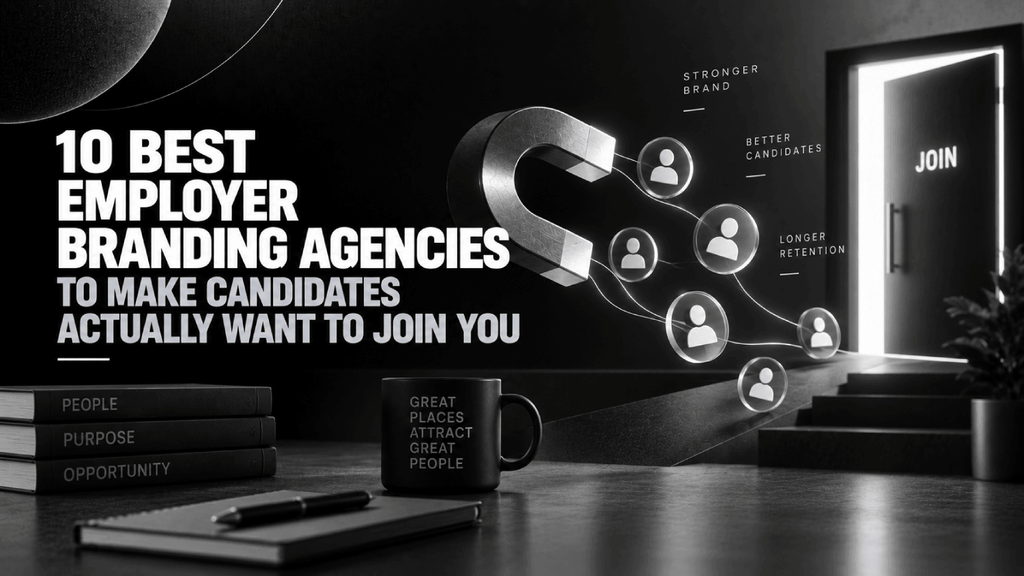
The best employer branding agencies build your EVP from primary research, translate it into a consistent candidate experience across careers sites, job descriptions, social content, and Glassdoor, and give you a measurable framework to track impact. Agencies that do this well include Universum, Blu Ivy Group, TMP Worldwide, Ph.Creative, Exaqueo, Employer Brand Labs, Cielo Talent, Stories Inc., Papirfly, and N2Growth, each suited to different company sizes and hiring challenges.
Most companies spend their employer branding budget in the wrong order. They buy creative before they understand what they stand for. A new careers page goes live with generic copy about “collaboration” and “impact.” Social media runs photos of office dogs and ping pong tables. Applications tick up slightly, then drop back. The quality of candidates does not change because the message was never differentiated to begin with.
The underlying problem is that employer branding is treated as a marketing execution problem when it is actually a positioning problem. You cannot solve a positioning problem with better photography. You need to know what makes your company a genuinely different place to work, for which types of people, and in which roles. That requires research. Agencies that lead with research produce strategies that last. Agencies that lead with creative produce assets that expire.
This guide covers ten agencies that take employer brand seriously, how to evaluate them for your situation, what a real engagement costs, and how to know when you are ready to hire one.
What Should an Employer Branding Agency Actually Deliver?
Before evaluating any agency, get clear on what a complete engagement produces. A discovery phase is table stakes: candidate persona development, current employee listening (surveys, focus groups, exit interview analysis), competitor brand audit, and Glassdoor review analysis. Without this, the EVP is invented rather than discovered.
The EVP itself is a written positioning framework, not a tagline. It articulates the specific reasons a defined candidate profile should choose your company over alternatives, grounded in what current employees actually value. From that framework flows everything else: careers site content architecture, job description language, social content pillars, employee advocacy programs, and recruiter talking points.
Activation is where most agencies earn or lose their fee. Delivering a 60-page EVP document that sits in a shared drive is not activation. The agency should help you translate the EVP into channel-specific content, train recruiters on how to use it in conversations, and establish metrics for tracking candidate sentiment before and after. If an agency cannot describe how they measure the impact of their work, they are selling you a brochure.
How Much Does an Employer Branding Engagement Cost?
Pricing varies significantly by agency tier, scope, and whether you need research, strategy, activation, or all three. Below is a realistic range based on market-rate estimates for each engagement type. Specific project pricing is quote-based at every agency listed here; treat these ranges as calibration, not guarantees.
| Engagement Type | Typical Scope | Realistic Budget Range |
|---|---|---|
| EVP Research and Framework Only | Research, persona development, EVP document | $40,000 to $100,000 |
| EVP + Careers Site Redesign | Research, strategy, new content and design | $100,000 to $250,000 |
| Full Brand Build and Campaign | Research, EVP, content, paid media, employee stories | $250,000 to $500,000+ |
| Retainer (Ongoing Content and Optimization) | Monthly content production, Glassdoor management, social | $8,000 to $25,000/month |
| Hard-to-Fill Technical Roles Campaign | Targeted content and media for specific talent pools | $50,000 to $150,000 |
Budget is a filter, not just a number. Agencies in the $40,000 to $100,000 range are typically right for mid-market companies (200 to 1,500 employees) doing their first structured EVP project. Enterprise programs with global reach and multiple candidate personas require larger budgets and more experienced project teams.
Which Agencies Build an EVP from Research Rather Than Assumption?
The following agencies are evaluated on four criteria: depth of discovery process, quality of EVP methodology, activation support, and fit by company size and sector. Pricing at all agencies is quote-based unless otherwise noted.
1. Exaqueo
Exaqueo is one of the most research-rigorous firms in this space. Their engagements start with what they call “employer brand research,” which means structured interviews with employees across levels, candidate experience audits, and competitive brand analysis before a single word of EVP copy is written. They work primarily with mid-market and enterprise companies in the US and position themselves as strategy-first, execution-second.
Their strength is in surfacing the authentic differentiators that employees actually talk about, not the aspirational claims that leadership wants to make. The weakness: they are a boutique, and availability can be limited. Best for companies that want a foundational EVP to own and build on internally, rather than handing ongoing execution to an agency indefinitely.
2. Ph.Creative
Ph.Creative is a Liverpool and New York-based employer brand agency known for deep candidate persona development. Their proprietary “Genius” methodology runs candidate research through structured listening to identify what they call the “Human Truth” behind a company’s EVP. They have worked with enterprise clients including global technology, financial services, and pharmaceutical companies.
Ph.Creative is a strong choice for companies hiring in technical and specialist roles where generic employer brand messaging fails. Their creative execution is high quality, and their candidate persona process is more rigorous than most. Expect senior leadership involvement in the discovery phase, which produces better output but requires more of your team’s time.
3. TMP Worldwide
TMP Worldwide is one of the largest pure-play recruitment marketing and employer branding agencies in North America. They cover the full stack from EVP development to careers site build, programmatic media buying, and employee advocacy programs. Their scale means they can run global campaigns that smaller agencies cannot staff.
The tradeoff for scale is sometimes standardization. Clients at the smaller end of their client range can feel underserved relative to larger accounts. TMP is best suited to enterprise companies (1,000+ employees) running multi-channel, multi-market talent attraction campaigns that need integrated media and technology alongside brand strategy.
4. Stories Inc.
Stories Inc. specializes in employee story content as a talent attraction mechanism. Their method is to film and document authentic employee experiences and translate them into content for careers sites, LinkedIn, and programmatic job advertising. This is different from a pure EVP strategy engagement: Stories Inc. assumes you have a brand position and helps you prove it through real employee voices.
They are particularly effective for companies where the EVP is credible but candidates do not believe it because external content does not reflect it. If your Glassdoor score does not match your culture, or candidates consistently say your employer brand feels corporate, Stories Inc. addresses the evidence gap rather than the strategy gap.
5. Employer Brand Labs
Employer Brand Labs sits at the intersection of employer brand strategy and employer brand technology, which is a genuinely useful combination. Their engagements help companies build EVP frameworks that connect directly to the talent acquisition tech stack, including how brand messaging flows through an ATS, career site, and candidate communications. For companies that have invested in applicant tracking systems for mid-market recruiting but have not aligned their brand messaging to candidate experience within those systems, this is the agency that closes the gap.
Their model suits tech-sector companies and companies hiring for technical roles where candidates evaluate employers as analytically as they evaluate job offers. Pricing is quote-based and tends toward the mid-market range.
6. Cielo Talent
Cielo Talent is primarily known as an RPO provider, but their employer branding practice is substantial and integrated with their talent acquisition delivery work. This makes them a practical choice if you are already using or considering an RPO arrangement, since your EVP, candidate communications, and recruiter messaging all come from the same team.
For companies asking whether to run employer branding separately from talent acquisition strategy, Cielo argues (credibly) that the two should be integrated. Their brand work tends to be more execution-oriented than research-heavy, so if you need deep primary research as the foundation, you may want to supplement with a strategy-only firm first.
7. Papirfly
Papirfly is not a traditional agency but a software platform with brand management and employer brand activation capabilities. Their platform lets companies centralize brand assets, create compliant job advertising content at scale, and distribute employer brand content across markets without a design team in the loop for every asset. This is especially relevant for enterprise companies with hiring across multiple countries or business units where brand consistency breaks down.
Papirfly is the right tool when your problem is activation at scale, not initial EVP strategy. If your EVP is solid but your careers content in Germany looks nothing like your careers content in Australia, Papirfly solves that. Pricing is subscription-based and quote-only.
8. N2Growth
N2Growth approaches employer branding from a leadership and organizational culture angle rather than a recruitment marketing angle. Their work tends to focus on companies where employer brand problems trace back to leadership perception, culture authenticity issues, or employer reputation challenges that surface on Glassdoor and in candidate feedback.
They are better suited to companies in organizational change (post-merger, post-layoff, or mid-transformation) where the brand work cannot be separated from the organizational narrative work. If your employer brand problem is fundamentally a trust problem, N2Growth addresses the root rather than the symptom.
9. Universum
Universum is best known for its global employer attractiveness research, particularly among student and early-career audiences. Their data on which employers rank highly among specific graduate talent pools in different countries is genuinely useful benchmarking. Their consulting arm helps companies use that research to position against competitors for early-career talent.
They are a strong choice for companies with significant early-career hiring volume or university recruiting programs, particularly in Europe and across global markets. For mid-career or senior hiring, Universum’s research lens is less directly applicable.
10. Blu Ivy Group
Blu Ivy Group is a Canadian employer brand consultancy that has built a reputation for work in healthcare, financial services, and public sector, sectors where employer brand is often underdeveloped relative to their competition for talent. Their EVP methodology involves both employee and candidate research and they have published thinking on connecting employer brand to employee experience, not just talent attraction.
They are worth considering for Canadian employers and US companies in regulated or care-delivery industries where the talent pool is specialized and reputation matters as much as compensation messaging.
How Do You Pick the Right Agency for Hard-to-Fill Technical Roles?
Technical candidates evaluate employers differently. A software engineer looking at two similar offers will check GitHub activity, engineering blogs, tech stack transparency, conference speaker rosters, and team composition before they read a careers page. Generic employer brand messaging does not move them.
The agencies best equipped for technical hiring are those that can develop candidate personas specific to engineering, data, or product talent rather than applying a one-size-fits-all EVP across all roles. Ph.Creative and Employer Brand Labs both invest in this kind of persona work. Stories Inc. can produce engineer-specific content that speaks to the work itself rather than the culture wrapper around it.
If you are hiring technical talent at scale, your employer branding investment should also connect to your sourcing strategy. The same research that informs your EVP should inform which channels you use to reach passive candidates. Pairing your brand work with a strong AI sourcing strategy compounds the return on both investments.
What Does a Glassdoor Strategy Actually Involve?
Glassdoor is the most visible external signal of employer brand health, and most companies manage it poorly. Responding to reviews is table stakes. A real Glassdoor strategy involves analyzing the pattern of feedback to identify the three to five themes candidates consistently mention, determining which are accurate reflections of culture and which are perceptual gaps that better communication can close, and then building content that addresses both.
Inauthentic Glassdoor management (mass-requesting positive reviews before a rating dips, or responding to negative reviews with corporate boilerplate) makes the problem worse. Candidates read through it. The agencies that do this well, Exaqueo and Stories Inc. among them, treat Glassdoor as a listening channel first, a publishing channel second.
For companies in competitive hiring markets, improving Glassdoor score by one point can meaningfully change inbound application quality. But the improvement has to come from culture changes that generate honest reviews, not from reputation management tactics that mask the underlying reality.
When Are You Actually Ready to Hire an Employer Branding Agency?
There are four signals that you need external help rather than an internal fix. First, your time-to-fill has grown but your sourcing volume has not dropped, meaning candidates are seeing you and passing. Second, offer acceptance rates are declining, which often signals that candidates are learning something in the process that was not in your brand message. Third, your Glassdoor reviews are consistent across departments, suggesting a structural perception problem rather than a management issue in one team. Fourth, you are entering a new market or talent pool where your brand has no recognition.
Internal employer brand teams can run ongoing content and social programs effectively. They rarely have the research infrastructure, the competitive benchmarking data, or the external perspective to build a foundational EVP from scratch. That is where agencies earn their fee.
Before hiring an agency, have your own house in order. You need access to exit interview data, willingness to run employee surveys, and internal stakeholders who can make decisions about what the brand should and should not claim. Agencies that start work without these inputs produce EVPs that leadership does not believe and employees do not recognize. The brief should go deeper on this point: an employer brand engagement that surfaces uncomfortable truths about culture gaps is doing its job. Many companies are not ready for that conversation.
Your employer branding work does not exist in isolation from your broader talent acquisition infrastructure. If your candidate interview experience or your onboarding contradict the brand promise, no amount of EVP investment fixes the leakage. Brand has to connect to every stage of the candidate experience.
What Should You Ask an Employer Branding Agency Before You Sign?
Most agencies present well. The differentiation shows up in their answers to specific process questions, not in their pitch decks.
- How many primary research interviews do you conduct with employees, and at what levels?
- How do you handle EVP elements that leadership wants to claim but employees do not validate?
- Can you show us an EVP deliverable from a past client in a similar industry?
- What metrics do you use to track employer brand performance, and at what cadence?
- How do you define the boundary between research-based EVP claims and aspirational messaging?
- What happens if our Glassdoor score or candidate feedback contradicts the EVP you have helped us build?
- What is your process for training internal recruiters to use the EVP in conversations?
An agency that struggles with the third or sixth question is more comfortable producing creative than doing the research that makes creative credible. That is a red flag at any budget level.
How Do Employer Branding Agencies Compare on Core Capabilities?
| Agency | Primary Research Depth | EVP Strategy | Careers Site Content | Employee Advocacy | Best Fit |
|---|---|---|---|---|---|
| Exaqueo | High | High | Medium | Medium | Mid-market to enterprise, US-focused |
| Ph.Creative | High | High | High | Medium | Technical hiring, enterprise |
| TMP Worldwide | Medium | High | High | High | Large enterprise, multi-market |
| Stories Inc. | Medium | Low | High | High | Content activation, mid-market |
| Employer Brand Labs | High | High | Medium | Medium | Tech sector, ATS-integrated brand |
| Cielo Talent | Medium | Medium | High | High | RPO clients, integrated TA |
| Papirfly | Low | Low | High | High | Enterprise brand scaling, multi-market |
| N2Growth | Medium | High | Low | Low | Culture change, leadership perception |
| Universum | High (external data) | Medium | Low | Low | Early-career, university recruiting |
| Blu Ivy Group | High | High | Medium | Medium | Healthcare, Canada, regulated sectors |
Frequently Asked Questions About Employer Branding Agencies
What is the difference between an employer branding agency and a recruitment marketing agency?
Employer branding agencies focus on defining what makes your company a distinctive place to work, which is a strategy and positioning exercise that starts with research. Recruitment marketing agencies focus on distributing and amplifying that message through paid media, social content, and programmatic job advertising. Many agencies do both, but they are different disciplines. An employer branding engagement without clear positioning first is just media spend on a weak message.
How long does a full EVP development project take?
A foundational EVP project typically runs 12 to 20 weeks from kickoff to final deliverables. Research and listening take four to six weeks. EVP framework development and validation with internal stakeholders takes another four to six weeks. Translating the EVP into content and activation materials takes the remainder. Companies that rush the research phase produce EVPs that do not survive contact with candidates or employees.
Can a small company (under 200 employees) benefit from employer branding work?
Yes, but the scope should match the budget and stage. A startup hiring 20 to 30 people per year does not need a $200,000 EVP build. It needs a clear articulation of why someone would join at this stage of the company’s growth, what the work environment is actually like, and honest content that proves it. A boutique agency engagement or a fractional employer brand consultant is often more appropriate than a full-service agency at this size. See our guide to fractional HR and people leaders for startups for adjacent options.
What is employee advocacy in an employer branding context?
Employee advocacy programs encourage current employees to share authentic content about their work experience on LinkedIn, Glassdoor, and social media. Done well, advocacy is the highest-credibility channel for employer brand because candidates trust peers more than corporate communications. Done badly, it is a compliance program that produces awkward LinkedIn posts nobody reads. Agencies that build advocacy programs focus on making it easy for employees to share their own stories, not on mass-producing approved content for employees to copy and paste.
How do I measure whether employer branding is working?
The metrics that matter most are application quality (not volume), offer acceptance rate, candidate experience survey scores at key stages of the funnel, and Glassdoor rating trajectory. Secondary metrics include career site traffic from non-branded search, time-to-fill for roles targeted by a campaign, and source mix (are more candidates coming through referrals and direct applications versus paid?). Volume metrics like social media impressions are leading indicators at best and vanity metrics at worst.
What is a brand audit in employer branding?
A brand audit is a structured assessment of how your employer brand currently appears across every touchpoint a candidate encounters: careers page, job descriptions, LinkedIn page, Glassdoor, Indeed, social media, press, and interview experience. It identifies gaps between the brand you intend to project and the brand candidates actually experience. Most employers are surprised by how much inconsistency exists across these channels. The audit output becomes the baseline against which post-engagement changes are measured.
Should employer branding agencies connect to our talent intelligence tools?
Increasingly, yes. Talent intelligence platforms can tell you which competitor employers your target candidates are considering, what benefits and culture attributes candidates in your talent pools value most, and where your brand perception ranks against alternatives in specific markets. This data should inform EVP development rather than being siloed in the recruiting team. Agencies like Employer Brand Labs explicitly build this connection. For companies already using talent intelligence platforms, sharing external labor market data with your employer branding agency improves the research foundation significantly.
Is employer branding different for companies with remote or distributed workforces?
Remote-first companies face a specific challenge: their employer brand cannot rely on physical environment, office culture, or local reputation. The EVP has to work harder to communicate how decisions get made, how teams collaborate across time zones, and what career growth looks like without proximity to leadership. Candidate personas for remote roles are also different because the candidate pool is nationwide or global, which means you are competing with a larger set of employers for the same talent. Stories Inc. and Ph.Creative have both done documented work in this area.
How Employer Brand Connects to the Broader Talent Acquisition Stack
Employer branding is not a standalone investment. Its return is compounded when connected to the rest of your talent acquisition infrastructure. A well-built EVP informs how your ATS communicates at every candidate touchpoint. It shapes the language your recruiters use in sourcing outreach. It determines which employee stories get featured in job advertising. Companies that treat employer brand as a marketing workstream separate from recruiting operations see weaker results than companies that integrate both.
If you are investing in employer branding, also audit your candidate experience from application to offer. A strong brand that sends candidates through a broken application process or a series of unstructured interviews contradicts itself. People operations leaders scaling a company will also find that employer brand work connects directly to retention: the same employee listening that informs your EVP tells you what is causing attrition. For companies building out the full talent acquisition function alongside brand work, our coverage of AI sourcing tools and recruiting technology covers the tech layer in depth.
The companies that get the most from employer branding engagements treat the EVP as a living document, not a deliverable to file. They run annual brand audits, track candidate sentiment continuously, and update their content as the company evolves. Brand drift is real: a company that articulates its EVP in year one and never revisits it will find that the message diverges from reality as the organization grows and changes. The agencies on this list that offer retainer relationships are selling ongoing alignment work, not just content production, and for companies hiring at volume, that ongoing investment pays for itself.