
TLDR
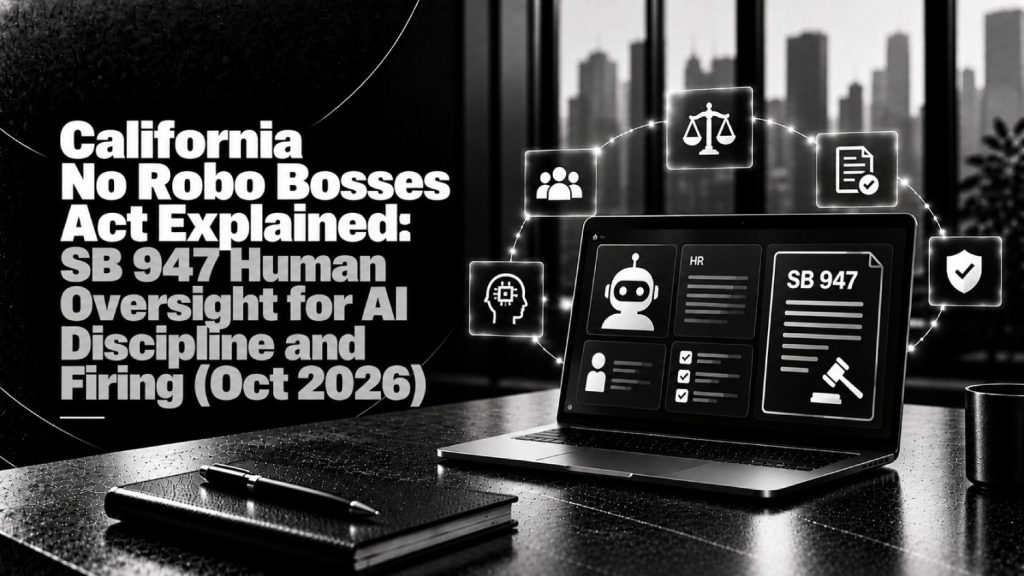
- On Sept. 30, 2026, California Gov. Gavin Newsom signed SB 947, known as the No Robo Bosses Act, the first US state law that blocks employers from relying solely on an automated decision system (ADS) to discipline or terminate an existing employee. Coverage: CNBC, Staffing Industry Analysts, and Fisher Phillips.
- Effective date: July 1, 2027. That window is the compliance runway for CHROs, CIOs, and HR-tech buyers, not a same-week product switch.
- If an employer primarily relies on an ADS for discipline or termination, a human reviewer must independently corroborate the output using the system data or other evidence (evaluations, personnel files, work product, peer reviews, witness interviews). A rubber-stamp approval is not enough, per CIO analysis.
- At notification time, the employer must give a separate plain-language written notice that ADS was primarily relied on, that a human corroborated it, that retaliation is prohibited, plus a human contact. Employees can request a meaningful description of the last 12 months of their own data the system used (one request per year).
- Coverage is existing employees only, not applicants. Gig deactivation language from earlier drafts was stripped. Civil penalty cited at $500 per violation, with Labor Commissioner and public-prosecutor enforcement paths; burden can flip to the employer once ADS use is shown.
- For buyers: this is a governance and architecture story for agentic HR, bossware, and performance/productivity scoring tools, not a vendor GA. Pair it with AI HR agents explained, AI HR vendor evaluation checklist, and AI HR vendor model monitoring clauses.
Sept. 30, 2026 gave California employers and every HR-tech vendor selling into the state a concrete AI-governance deadline, not another feature launch.
Governor Newsom signed SB 947 after vetoing a broader 2025 version. The signed law is narrower, but it is still the first statewide rule that forces a human into the loop when AI is the primary basis for disciplining or firing someone who already works for you. That is a different buyer question from NYC Local Law 144 bias audits for hiring tools, from EU AI Act high-risk employment systems, and from the hub product explainers on Workable Agents, Paychex WISE Hire, Warp Agent, or LinkedIn Hiring Assistant 2.
This draft sticks to the signed-bill facts from primary legal and news sources, what changed from earlier drafts, and the evaluation questions California (and multi-state) buyers should put to vendors before July 1, 2027. It is not legal advice and not a rewrite of the evergreen AI-agent or bias-audit guides already on the site.
What Newsom signed
Per CNBC, Staffing Industry Analysts, and Fisher Phillips:
- SB 947 / No Robo Bosses Act was signed Sept. 30, 2026 and takes effect July 1, 2027.
- Employers may not rely solely on an automated decision system to discipline or terminate an existing employee.
- An ADS is defined broadly as a computational process from machine learning, statistical modeling, data analytics, or AI that produces a simplified output (score, classification, recommendation) used to assist or replace human discretionary decision-making. Ordinary IT infrastructure (spam filters, firewalls, antivirus, IAM, calculators, databases, datasets) is carved out.
- If the employer primarily relies on an ADS output for discipline or termination, a human reviewer must corroborate that output using the producing data or other relevant information. If the reviewer cannot corroborate it, or finds it inaccurate, incomplete, or misleading, the employer cannot use that output to support the decision.
- When the decision is communicated, the employer must deliver a standalone plain-language written notice stating primary ADS reliance, human corroboration, a no-retaliation statement, and contact information for a human who can explain the decision.
- Separately, employees can request a meaningful, objective description of the last 12 months of their own data the system used, limited to one request per year.
- Author State Sen. Jerry McNerney told CNBC: “No worker should ever be fired or disciplined by a machine, AI or not. Artificial intelligence systems have the potential to boost productivity, but they’ve also made errors and misjudgments and exhibited bias.”
- Lorena Gonzalez, president of the California Federation of Labor Unions, AFL-CIO, said after the signing: “When working people organize, we get results. Workers across California have demanded that our state lead the way in regulating AI in our workplaces.”
Treat quotes as attributed public statements. Your counsel still owns the statutory reading for your fact pattern.
What the final law is not
Fisher Phillips stresses how much narrower the signed bill is versus earlier versions and the 2025 vetoed bill:
- Employees, not all “workers.” Gig worker deactivation language was removed. Rideshare-style deactivation is out of scope of this statute as signed.
- Existing employees, not applicants. Hiring-side ADS rules remain a different stack (for example NYC Local Law 144). Do not conflate SB 947 with applicant screening mandates.
- No pre-use broadcast notice of the kind Newsom cited when he vetoed the 2025 bill. The signed law centers post-use notice at the decision moment for primary-reliance discipline/termination cases.
- No required vendor-name / impact-assessment dump in the notice package that earlier drafts pushed.
- No express private right to sue in the final text the way earlier drafts framed it, though Fisher Phillips flags burden-shifting language that plaintiffs’ counsel will test.
- Union CBA opt-out is available if the agreement clearly waives the law, covers wages and working conditions, and provides protection from algorithmic management.
Chamber of Progress and other business groups opposed the bill in part because “primarily relies” is undefined. That ambiguity is a buyer and process-design problem, not a reason to ignore the statute.
Companion California AI workplace bills from the same signing window
Staffing Industry Analysts notes other Sept. 30, 2026 AI workplace bills in the same package, including AB 1883 (limits AI-powered workplace surveillance that collects neural data or predicts emotional state) and AB 1331 (limits surveillance tools in restrooms). Those are related governance stories. They are not SB 947. Keep this piece on No Robo Bosses unless you intentionally expand into a multi-bill package article.
Fisher Phillips also warns that SB 947 notice compliance does not automatically satisfy California Privacy Protection Agency automated decision-making technology (ADMT) obligations under CCPA for covered businesses. Privacy and employment AI stacks can both apply.
Enforcement and risk shape
| Signal | What sources report | Buyer use |
|---|---|---|
| Effective date | July 1, 2027 | Build inventory, review protocol, notice templates now |
| Civil penalty | $500 per violation (plus possible injunctive relief, punitive damages, attorneys’ fees paths) | Treat wrongful-termination exposure and proof gaps as the larger risk than the fine alone |
| Enforcement | Labor Commissioner citations/civil actions; public prosecutors can also sue | Align Legal, HR, and IT on documentation standards |
| Burden shift | Once ADS use in a disciplinary decision is shown, employer may need to prove it did not primarily rely or that it fully complied | Document what the human reviewed, when, and the corroboration conclusion |
| Scope | Discipline and termination of existing employees | Separate from applicant AEDT / Local Law 144 workflows |
CIO quotes Frank Dickson: “A machine can recommend, but a human must decide.” The practical test he describes is whether the human checked the evidence and had real power to say no, not whether they forwarded the bot’s verdict.
Why this matters for HR tech buyers and vendors
HrTechSaas has been covering the agent wave: Workable recruiting agents, Paychex WISE Hire, Warp Agent, Rippling AI Lab, UKG Bryte / Agentic Pay, ADP Assist agents, LinkedIn Hiring Assistant 2. Those pieces answer product capability questions. SB 947 answers a different one: when an agentic or scoring system touches discipline or termination for California employees, what architecture and process must sit around it?
Useful site companions:
- AI HR agents explained for agent vs copilot liability posture
- HR copilots vs HR agents for which decisions should stay human-gated
- Best AI HR compliance / bias audit tools for hiring-side AEDT audit reality (NYC and beyond)
- AI HR vendor evaluation checklist and AI HR vendor model monitoring contract clauses for contract language
Do not merge this into those evergreen pages. This is same-week signed California statute news with a dated effective date. Different announcement, different buyer job.
Fisher Phillips 5-step plan buyers should operationalize
From the Fisher Phillips compliance plan:
- Inventory every AI tool that could feed discipline or termination: productivity scoring, attendance tracking, quality monitoring, customer-review aggregation, performance dashboards, route optimization, and similar. Ask vendors if the product outputs a score, classification, or recommendation.
- Define “primarily relied upon” internally. The statute does not. Document which tools trigger the full protocol versus background information.
- Build a human review protocol with a paper trail. Name reviewers, required evidence, and how conclusions are recorded. A checkbox that the reviewer “agreed” may not survive burden shifting.
- Draft the post-use notice template now. Deliver it with the decision, translate for languages you use in routine workforce communications, and identify the human contact by role so the template survives turnover.
- Train managers and build the annual data-request workflow. A system flag should mean look closer, not auto-terminate. Produce meaningful employee data descriptions while protecting others’ private information.
CIO’s takeaway list is aligned: inventory tools, name reviewers with real authority, require vendor explainability of inputs, retain corroboration records, and build the notice template before the effective date.
How this differs from other hub drafts and site pages
Hub drafts already cover product news: UKG Bryte / Agentic Pay; ADP AWS Assist; Workday Gartner WFM MQ; Workable Agents GA; Rippling AI Lab Bengaluru; Workday Payroll by Neeyamo; Paychex WISE Hire; Workday Cash App + Experian; Warp Agent; SalaryTalent; Neeyamo Compass; LinkedIn Hiring Assistant 2; Gusto Business Compliance.
Site pages already cover NYC Local Law 144, EU AI Act employment high-risk rules, Colorado AI hiring themes, and general agent governance. None of those is a California SB 947 No Robo Bosses signed-law explainer.
This draft is different:
- Same-signing-window California SB 947 news (signed Sept. 30, 2026)
- Focus on discipline/termination human corroboration for existing employees, effective July 1, 2027
- Not a product GA, not a hiring AEDT bias-audit guide, not an agent feature explainer
Who should care, and what to ask
Prioritize a read-out if you:
- Employ people in California and use productivity, attendance, quality, or performance AI that can feed discipline or termination
- Sell or buy agentic HR / HCM tools that recommend or trigger adverse actions
- Are a multi-state CHRO or CIO aligning AI governance with NYC LL144, EU AI Act, and now California SB 947
- Are reviewing vendor contracts for explainability, input logs, human-in-the-loop controls, and California employment AI clauses
Ask vendors and counsel before July 1, 2027:
- Which of your modules produce a score, classification, or recommendation that managers could use in discipline or termination for California employees?
- Can a reviewer see the inputs behind an output, export them, and retain them outside IT-only systems?
- Does the product support a forced human approval gate with an evidence checklist before an adverse action is finalized?
- Can you generate or attach a plain-language post-use notice package at decision time?
- How do you support annual employee data-description requests without exposing other workers’ or customers’ data?
- What is your contractual position if an employer is cited under SB 947 after using your ADS output?
- For unionized California sites, what CBA waiver language and algorithmic-management protections would you expect customers to negotiate?
- How does your California employment AI posture interact with CCPA ADMT and with hiring-side rules such as NYC Local Law 144?
The take: California just set the human-in-the-loop floor for firing AI
No Robo Bosses is not a ban on workplace AI. It is a ban on solely automated discipline and termination for existing California employees, plus a corroboration-and-notice regime when AI is the primary basis for those decisions.
Your job as a buyer is narrower. Inventory the tools that can score or flag people. Decide what “primarily relies” means in your process. Give reviewers real evidence and real authority. Build the notice and data-request workflows before July 1, 2027. Use the agent and vendor-checklist posts for product evaluation, and use this statute explainer for the California adverse-action governance bar that sat next to those products on Newsom’s desk.
FAQ
What is the California No Robo Bosses Act?
It is SB 947, signed Sept. 30, 2026 by Gov. Gavin Newsom. It restricts how California employers use automated decision systems in discipline and termination decisions about existing employees, with an effective date of July 1, 2027.
Does it ban AI in HR entirely?
No. Employers can still use ADS tools. They cannot rely solely on them for discipline or termination of existing employees, and if they primarily rely on an ADS output they must have a human corroborate it and issue a required notice.
Does it cover hiring or applicants?
Fisher Phillips’ signed-law reading is that SB 947 applies to decisions about existing employees, not applicants. Hiring-side automated tools remain under other frameworks such as NYC Local Law 144 where those rules apply.
What does “primarily relies” mean?
The statute does not define it. Counsel and employers need an internal standard. Business groups flagged that ambiguity as a compliance risk. Prudent buyers document when a tool starts the adverse-action conversation and treat those cases as in scope.
What must the employee notice include?
A separate plain-language written notice at decision time stating that the employer primarily relied on an ADS, that a human reviewer corroborated the output, that retaliation is prohibited, and contact information for a human who can explain the decision. Employees can also request a description of their own data used by the system over the prior 12 months (once per year).
What are the penalties?
Sources cite a $500 civil penalty per violation, with Labor Commissioner and public-prosecutor enforcement paths, plus possible injunctive relief, punitive damages, and attorneys’ fees. Documentation failures matter because the burden can shift to the employer once ADS use is shown.
How does this relate to AB 1883?
AB 1883 is a companion Sept. 30, 2026 bill limiting certain AI workplace surveillance uses involving neural data or emotional-state prediction. It is related California AI workplace policy, not a substitute for SB 947 compliance.
What should buyers do next?
Inventory ADS tools that touch discipline or termination, define primary-reliance triggers, design corroboration and notice workflows, update vendor contracts for input visibility and audit logs, and train managers before July 1, 2027.