
HR Tech SaaS may earn a commission when you buy through links on this page. Our recommendations are editorial and never paid for.
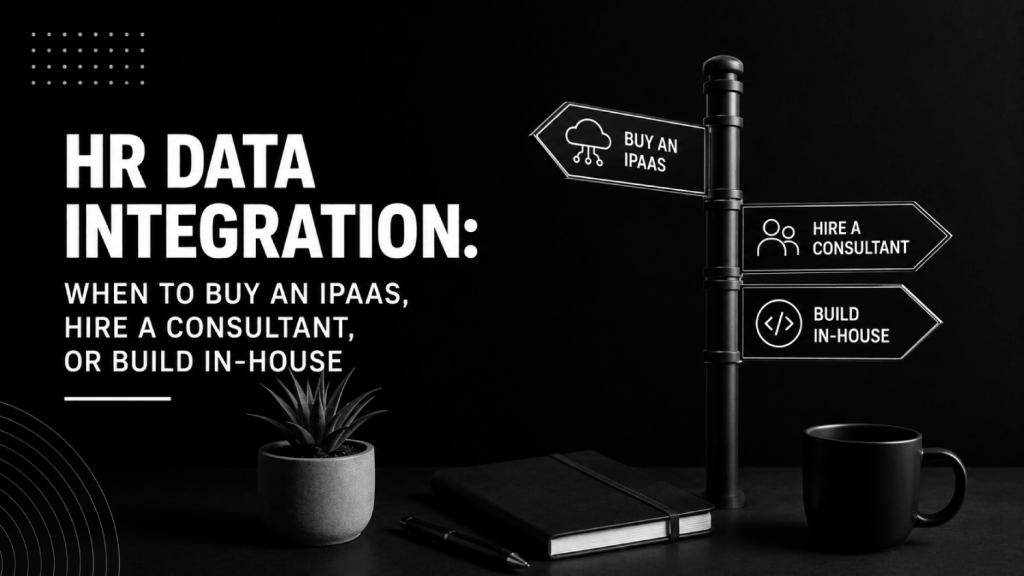
- Most HR teams default to one approach for data integration without knowing the real costs of the alternatives.
- iPaaS platforms (Boomi, MuleSoft, Workato, Celigo) work best when you have recurring, high-volume sync needs between two or more stable systems and internal technical resources to configure and maintain them.
- An integration consultant makes sense when you are mid-implementation, switching platforms, or dealing with a complex, one-time connection that has compliance or payroll stakes.
- Building in-house only pays off at significant scale, with a dedicated engineering team and data infrastructure already in place.
- Most mid-market HR teams (200 to 2,000 employees) end up underestimating ongoing maintenance and should start with iPaaS or a consultant rather than custom code.
HR data integration covers any approach that gets your HRIS, ATS, payroll, benefits, and adjacent tools passing data reliably between each other. The three main routes are: buying an iPaaS platform that handles the connections for you, hiring a specialist consultant to build or fix integrations, or writing custom integration code in-house. Each fits a different combination of technical capacity, budget, timeline, and system complexity. There is no universally correct answer, but most buyers in the 200-to-2,000-employee range will find iPaaS is the fastest path to reliable, maintainable data flow.
Why Is HR Data Integration Harder Than It Looks?
Every HR team eventually hits the same wall. Payroll does not know about a new hire until HR manually exports a CSV. The ATS candidate record never makes it cleanly into the HRIS. A manager in one system has a different headcount than the finance system shows. These are not edge cases. They are the default state of any company running more than three HR tools that were purchased independently.
The core problem is that HR software vendors build their products to be used, not necessarily to share data. Native integrations exist, but they are almost always limited: one-directional, infrequently synced, or only covering the most common fields. The moment you have a non-standard field (a custom cost center, a job grade that does not map cleanly, a benefits class that depends on location and employment type simultaneously), native integrations break down.
The hidden cost is not the initial connection. It is the ongoing maintenance as systems update, APIs change, and data structures drift. This is what most buyers fail to price in when choosing their approach. For a deeper look at where HR data stacks tend to break down, the guide on tools to clean, connect, and use workforce data lays out the common failure points.
What Is iPaaS and When Does It Make Sense for HR Integration?
iPaaS (Integration Platform as a Service) is a cloud-hosted middleware layer that connects two or more software systems through pre-built connectors and configurable workflows. Rather than writing custom code to sync your HRIS to payroll, you configure a workflow in the iPaaS platform that watches for changes in System A and pushes them to System B on a defined schedule or trigger.
The major enterprise-grade iPaaS platforms used for HR data integration include Boomi, MuleSoft, Workato, Celigo, and Azure Logic Apps. Lighter-weight options like Zapier and Make cover simpler, lower-volume use cases. Pricing is not standardized across these vendors. MuleSoft and Boomi operate on quote-based enterprise contracts. Workato and Celigo have tiered plans that are partially public but depend heavily on connector count and task volume.
When iPaaS is the right call
iPaaS earns its cost when you have recurring, bidirectional sync requirements between stable systems and someone internal who can configure and maintain the workflows. If your HRIS, payroll, and benefits administrator all need to stay in sync continuously, and this is not a one-time project, iPaaS gives you a governed, auditable layer that does not require a developer every time a field changes.
It also makes sense when you are connecting systems that already have iPaaS connectors built. Boomi, for example, has pre-built connectors for Workday, SAP SuccessFactors, ADP, BambooHR, and many common ATS platforms. Those connectors compress the implementation timeline significantly compared to building a custom integration from scratch.
When iPaaS is the wrong call
If the integration project is genuinely one-time (migrating data from an old HRIS to a new one, for instance) then paying for an ongoing iPaaS subscription to run a project you will only do once rarely makes financial sense. A consultant or a one-time data migration service is almost always cheaper for that scenario.
iPaaS also falls short when your HR team has no internal technical capacity. These platforms are configurable, not code-free. Someone needs to understand data mapping, error handling, and what to do when a sync fails at 2 a.m. on a payroll run day. If that person does not exist internally, you are buying a tool you cannot maintain.
When Should You Hire an HR Integration Consultant Instead?
An HR integration consultant brings both technical and domain expertise. They know how ADP processes payroll feeds, what Workday’s API limitations look like in practice, and how to structure a HRIS-to-benefits-admin integration so it does not break every open enrollment. That combination of system-specific knowledge and HR process fluency is what separates a good integration consultant from a generic IT contractor.
Consulting engagements for HR data integration services typically fall into three patterns: full implementation (they build the integration from scratch), advisory (they specify what to build and you or an iPaaS handles it), and triage (you have a broken integration and need someone to diagnose and fix it fast).
When a consultant is the right call
Hire a consultant when the integration has payroll, compliance, or benefits implications and you cannot afford to get it wrong. Payroll integrations that fail mean employees are not paid correctly. Benefits eligibility feeds that are wrong mean people enrolled in plans they should not be in, or excluded from plans they should have. The cost of a consultant is almost always less than the cost of fixing those downstream errors.
A consultant also makes sense during platform switches. Migrating from Paychex to ADP, or from BambooHR to Rippling, involves extracting and transforming years of historical employee data. Most iPaaS platforms are not designed for one-time transformation projects at that complexity. A specialist, particularly one who has done that exact migration before, compresses timelines and catches edge cases a first-timer will miss. The roundup of best HRIS implementation partners for mid-market companies covers firms that specialize in exactly this kind of work.
When a consultant is the wrong call
Consultants are expensive for ongoing work. If your integration needs are recurring and stable (employee data syncing to payroll weekly, new hire records flowing to IT provisioning on start date), paying consultant hourly rates to monitor and maintain that indefinitely costs more than an iPaaS subscription within a few months. Consultants are for project work, not operational maintenance.
Also watch for consultants who propose custom-coded integrations when a pre-built iPaaS connector already exists. Custom code creates long-term dependency on that consultant and makes future changes expensive. A good consultant will tell you when iPaaS is the better answer, even if it means less work for them.
When Does Building HR Integrations In-House Actually Make Sense?
In-house integration development means your engineering team writes and maintains the code that connects your HR systems. This is either REST API calls handled in a custom service, an ETL pipeline your data engineers maintain, or a combination of both. It requires real engineering capacity, not occasional IT help.
Building in-house makes sense in a narrow set of conditions: you have a dedicated engineering team already supporting internal systems, your integration requirements are highly proprietary (custom data structures that no iPaaS connector covers), and you have the volume and complexity to justify the ongoing engineering overhead. Most technology companies at 500-plus employees with a mature data infrastructure end up doing some in-house integration work for their most critical data pipelines.
The honest math on building in-house
The real cost of a custom integration is not the initial build. An engineer or data analyst spending two weeks building an HRIS-to-payroll sync is not the line item that will hurt you. The ongoing cost, which includes maintenance when vendors update their APIs, debugging when a sync fails silently, and re-engineering when you switch any of the connected systems, is what makes in-house development expensive over a three-to-five year horizon.
Enterprise HR platforms like Workday, SAP SuccessFactors, and Oracle HCM update their APIs regularly. Custom integrations built against those APIs require corresponding updates. If your engineering team is not familiar with those specific platforms, debugging integration failures becomes disproportionately time-consuming. The comparison of Workday AI vs SAP Joule vs Oracle AI for HR gives useful context on how differently these platforms handle external integrations and data access.
Side-by-Side: iPaaS vs. Consultant vs. In-House for HR Data Integration
| Factor | iPaaS | Integration Consultant | In-House Build |
|---|---|---|---|
| Best fit | Recurring, stable sync between 2+ systems | Complex one-time build or platform migration | Proprietary requirements, dedicated engineering team |
| Internal skill required | Technical admin or ops analyst | Project management; vendor liaison | Software engineers; data engineers |
| Upfront cost | Medium (platform license + setup time) | High (project fees, often $20K to $150K+) | Low cash, high opportunity cost |
| Ongoing cost | Predictable subscription | Low if project-scoped cleanly | High (engineering time, API maintenance) |
| Speed to live | Weeks (if connector exists) | Weeks to months depending on scope | Months minimum for anything complex |
| Maintenance burden | Platform handles infrastructure; you manage workflows | Minimal post-project if well-documented | Ongoing; scales with system changes |
| Risk of failure | Connector gaps; API rate limits | Scope creep; consultant dependency | Knowledge concentration; API drift |
| Compliance suitability | Good, if the platform is SOC 2 certified | Depends on consultant’s data security practices | Fully controlled, but requires internal governance |
How Do You Match Your Situation to the Right Approach?
The most common mistake is treating integration as a technical decision rather than a business decision. Before choosing an approach, answer three questions: How often does this data need to move? What is the downstream consequence of a sync failure? Does anyone internal have the skills to maintain this after it is built?
High frequency plus low failure tolerance points to iPaaS or in-house, not a one-and-done consulting engagement. Low frequency plus high complexity (think: a payroll migration from one vendor to another) points to a consultant. Novel, proprietary requirements with an engineering team already in place points to in-house. Most mid-market HR teams find they need a combination: iPaaS for ongoing sync operations, a consultant for the initial setup or a specific migration project.
The company size signal
Under 200 employees: your HRIS probably has native integrations that cover most use cases. If they do not, Zapier or Make can handle lightweight sync. Spending on enterprise iPaaS or a consultant at this stage is usually premature. Focus first on picking platforms with strong native connectivity. The guide on building an HR tech stack for a 50-person startup covers what to buy and what to skip.
200 to 1,000 employees: this is where iPaaS earns its value. You likely have three to six HR systems, custom fields that native integrations cannot handle, and a growing payroll complexity. Boomi, Workato, or Celigo are worth evaluating here, alongside a consultant for initial configuration if you lack internal technical resources.
1,000-plus employees: at this scale, a hybrid approach is common. Enterprise iPaaS for standard HR data flows, in-house engineering for highly proprietary pipelines, and consultants brought in for specific migrations or compliance-sensitive integrations. Firms like those listed in the best Workday consulting firms roundup specialize in exactly this kind of enterprise-scale integration work.
What Are the Real Costs of Each HR Integration Approach?
Pricing across all three approaches is frustratingly opaque. Enterprise iPaaS platforms (MuleSoft, Boomi) do not publish standard rates; contracts are negotiated based on data volume, connector count, and support tier. Workato’s public pricing starts at a lower tier but scales quickly with task volume. Celigo has published tiered pricing that is worth requesting directly from their sales team, as the public page provides ranges rather than firm numbers.
Integration consultant fees for HR data integration projects vary by scope and firm. A straightforward HRIS-to-payroll integration with a known platform pair can run as low as $15,000 to $25,000 for a fixed-scope engagement. Complex migrations involving multiple systems, data transformation, and compliance requirements regularly exceed $100,000. Hourly rates for specialized HR integration consultants are not standardized; expect wide variation depending on whether you are working with a boutique HR tech consultancy or a major systems integrator.
In-house build costs are mostly opportunity cost. An engineer spending six weeks building and testing a payroll integration is not building product. The downstream maintenance cost, typically estimated qualitatively rather than published as data, is real and compounds over time as systems change. Understanding where HR software costs hide is covered well in the breakdown of hidden costs of HR software beyond the license fee.
What Should You Ask Before Choosing an HR Data Integration Service?
Regardless of which approach you lean toward, five questions will reveal whether it is the right fit before you commit.
- Does a pre-built connector exist for both systems? If yes, iPaaS becomes significantly faster and cheaper. If no, factor in custom connector development time and cost.
- What happens when the sync fails? Every approach needs a failure alert mechanism and a documented recovery process. Ask specifically about payroll run days.
- Who owns this after it goes live? A consultant who builds and leaves, without documentation and a handover, creates dependency. An iPaaS tool your team cannot configure creates the same problem.
- How often do the connected systems change their APIs or data models? Vendors with frequent breaking API changes (a real issue with some HCM platforms) increase the maintenance cost of both iPaaS and in-house approaches.
- What data governance and compliance requirements apply? Employee data crossing system boundaries has GDPR, CCPA, and potentially HIPAA implications depending on what is being synced. Any integration approach needs to account for data residency, access controls, and audit logging.
Frequently Asked Questions About HR Data Integration Services
What exactly counts as an HR data integration service?
An HR data integration service is any product, platform, or professional service that connects two or more HR-related systems to share data reliably. This includes iPaaS platforms that automate data flows (Boomi, Workato, MuleSoft), managed integration services offered by HR vendors or third parties (such as ADP’s API Central with Flexspring), and consulting firms that build custom integrations between HRIS, payroll, ATS, benefits, and finance systems.
What is the difference between a native integration and an iPaaS integration?
A native integration is built by one of the two connected vendors, typically covering standard fields and common use cases. An iPaaS integration is built on a middleware platform and can cover custom fields, complex transformations, and multi-system workflows that native integrations cannot. Native integrations are simpler to activate but have strict limitations. iPaaS integrations require more setup but handle edge cases that native connections miss.
Is Boomi suitable for mid-market HR teams, or is it enterprise-only?
Boomi is used by mid-market companies, but its pricing and complexity are most justified at the upper end of that range (500-plus employees) where integration volume and system complexity warrant the investment. Smaller organizations often find Workato, Celigo, or lighter-weight tools more cost-effective for their integration needs. Boomi’s pre-built HR connectors are a meaningful advantage when your core systems (Workday, ADP, SAP SuccessFactors) are on its supported list.
How long does a typical HR system integration project take with a consultant?
Scope determines timeline more than anything else. A single, well-defined integration between two platforms with documented APIs can take four to eight weeks. A payroll migration or a multi-system integration project involving data transformation, testing in a sandbox environment, and compliance review can take three to six months. Consultants who have done the specific platform combination before (ADP to Workday, for example) consistently deliver faster than generalists learning the system on your project.
When should I not use an iPaaS for HR integrations?
Skip iPaaS when the project is genuinely one-time, when no pre-built connector exists for your systems, or when your team lacks anyone who can configure and maintain workflows. Also avoid iPaaS if your data volume is low and the integration is simple enough that a native connector or a lightweight automation tool handles it. Paying enterprise iPaaS rates for a two-system sync that fires once a day and covers a hundred employees is poor use of budget.
What HR systems are hardest to integrate?
Legacy payroll systems with flat-file or SFTP-only data exchange (some older ADP and Paychex configurations fall here) are consistently the hardest to integrate cleanly. Custom-built internal HR tools without documented APIs are equally difficult. On the modern-platform side, Workday’s integration layer has significant flexibility but requires Workday-specific expertise (Workday Studio, EIB, or PECI feeds) that generalist developers do not have. Any integration involving benefits carriers tends to be complicated by non-standard data formats on the carrier side.
Can I combine iPaaS and a consultant on the same project?
Yes, and this is often the most practical approach. A consultant handles the initial configuration of your iPaaS workflows, the data mapping, and the testing. Once the integration is live and documented, your internal team or a technical operations hire takes over ongoing management. This avoids the trap of either building a dependency on ongoing consulting fees or leaving your team with an iPaaS tool they do not know how to use. The consultant’s role is to transfer knowledge, not just deliver a working connection.
The Bottom Line on Choosing Your HR Integration Approach
The instinct to find one right answer for HR data integration is understandable but misleading. Each approach exists because a real set of circumstances justifies it. The decision comes down to whether your integration need is ongoing or one-time, what the cost of failure is, and whether the internal skills exist to maintain what gets built.
For most mid-market teams, iPaaS is the most defensible long-term investment for operational sync requirements, and a consultant is the right call for any project with payroll, compliance, or migration complexity. Building in-house makes sense only when you have engineering capacity that is already paid for and requirements that no off-the-shelf connector handles. Mixing approaches across different integration needs is normal, not a sign of indecision.
Before you sign anything, verify that whoever you hire or whatever you buy has a documented answer to the failure scenario question. What happens at 5 p.m. on a payroll run Friday when the sync breaks? If the answer is vague, the integration strategy is not finished yet. For HR teams working through broader technology stack decisions alongside integration choices, the HR software implementation checklist covering data migration, integrations, and rollout planning is a practical place to pressure-test your plan.