
HR Tech SaaS may earn a commission when you buy through links on this page. Our recommendations are editorial and never paid for.
- At 500 employees, you have outgrown the HRIS tools built for teams under 100. The platforms that got you here rarely have the reporting depth, permission structures, or compliance automation you now need.
- Finding the best HRIS for 500 employees depends on three variables: whether you run payroll in-house, how many states or countries you operate in, and how complex your org structure is.
- Platforms like Rippling, Paylocity, Paycor, and HiBob all target this size band but solve different problems. Picking the wrong one means a painful 18-month implementation for a tool that still cannot generate the headcount reports your CFO wants.
- Implementation support matters as much as features at this size. A platform with a weak implementation track record is a risk at 500 employees in a way it simply is not at 50.
- This list covers ten HRIS platforms worth evaluating, with an honest read on who each one actually serves well.
The best HRIS platforms for 500-employee companies are Rippling, Paylocity, Paycor, HiBob, ADP Workforce Now, Paycom, UKG Ready, Lattice, Namely, and Ceridian Dayforce. Each targets the mid-market but with different strengths: Rippling leads on IT and payroll automation, Paylocity on employee experience, Paycor on compliance, HiBob on people analytics, and ADP Workforce Now on payroll breadth for complex multi-state setups.
Why a 500-Employee Company Cannot Use a Startup HRIS
Most early-stage companies land on BambooHR, Gusto, or Justworks because they are easy to set up and cheap. At 500 employees, those platforms start to crack. Not because they are bad products, but because they were not designed for the admin complexity you now carry.
At this size, you typically have multiple departments with different PTO policies, a finance team demanding monthly headcount variance reports, managers who need self-service without accidentally seeing salary data, and potentially 10 to 30 states with different tax and leave compliance requirements. A startup HRIS handles none of that gracefully.
The gaps show up fast. Reporting is the first failure point: most lightweight platforms cannot produce the org-level analytics a CFO expects. Permission structures are the second: you need granular role-based access, not a binary admin-or-employee toggle. Workflow automation is the third: offer letter generation, onboarding task sequences, offboarding checklists, and performance review cycles need to run without manual intervention at 500 heads. Platforms built for 50 people make all of that harder than it should be.
Before comparing tools, it helps to have a clear picture of what you are actually buying. Our HR software buying checklist covers 75 questions to ask any HRIS vendor before signing a contract.
What Should a Mid-Market HRIS Actually Do?
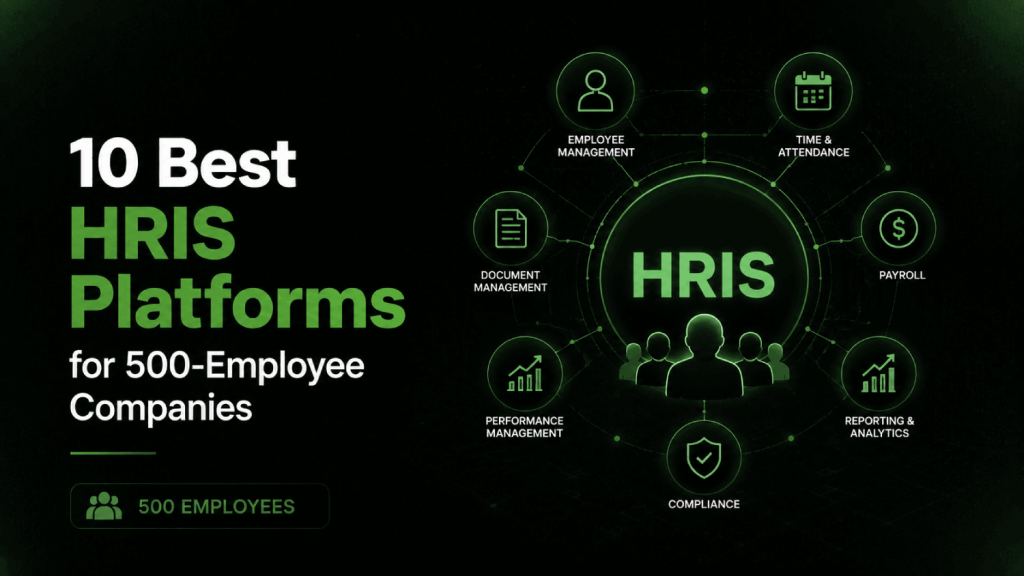
At the 500-employee mark, a real HRIS covers more than employee records and time-off tracking. The core capability set you need includes multi-level org charts, role-based permissions, workflow automation for onboarding and offboarding, configurable reporting, compliance tracking across multiple states or countries, manager self-service, and either native payroll or a deep integration with a payroll provider.
Beyond the basics, the features that separate mid-market platforms from entry-level tools are: benefits administration with carrier connectivity, custom fields for org-specific data, audit logs for compliance, and headcount planning that ties to your finance system. These are not nice-to-haves at 500 employees. They are the operational floor.
Some platforms also bundle performance management, engagement surveys, and learning modules. Whether that matters depends on your stack. If you already pay for Lattice or Culture Amp separately, a bundled performance module from your HRIS is redundant. If you do not, a bundled option can reduce vendor count without sacrificing much depth.
How to Compare HRIS Platforms for a 500-Person Company
The comparison frame most buyers use is wrong. Comparing feature checklists vendor by vendor produces a spreadsheet where everyone wins. The better frame is: what does your company’s specific complexity look like, and which platform was actually built for that complexity?
Five variables drive the right choice:
- Payroll dependency: Do you need native payroll, or do you already run payroll somewhere and just need a clean integration? Platforms with native payroll (Paylocity, Paycor, Paycom, ADP) eliminate sync errors but create lock-in. Pure HRIS platforms (HiBob, Lattice) offer more flexibility but require a reliable payroll connector.
- Geographic complexity: Multi-state US companies need automated state tax and leave compliance. International companies need either a platform with global capabilities or a separate Employer of Record layer.
- Org structure complexity: A flat startup with one location has different needs than a 500-person company with five business units, two acquisition entities, and a field workforce. Platforms like UKG Ready and Ceridian Dayforce handle the latter better.
- Implementation risk tolerance: Enterprise-adjacent platforms (Ceridian Dayforce, ADP Workforce Now) have longer, more complex implementations. Lighter platforms (HiBob, Rippling) claim faster time-to-value. Verify this with references, not vendor claims.
- Budget model: Most mid-market HRIS platforms price per employee per month and do not publish pricing publicly. Expect quote-based pricing for almost every platform on this list. The per-employee cost varies based on modules selected, contract length, and negotiation.
The 10 Best HRIS Platforms for 500-Employee Companies
| Platform | Best For | Native Payroll | Global Support | Pricing |
|---|---|---|---|---|
| Rippling | IT-heavy or distributed teams | Yes | Yes (limited) | Quote-based |
| Paylocity | Employee experience focus | Yes | Limited | Quote-based |
| Paycor | Multi-state US compliance | Yes | Limited | Quote-based |
| HiBob | People analytics, remote orgs | No (integrates) | Yes | Quote-based |
| ADP Workforce Now | Complex US payroll + compliance | Yes | Partial | Quote-based |
| Paycom | Single-database US operations | Yes | No | Quote-based |
| UKG Ready | Hourly + salaried mixed workforce | Yes | Limited | Quote-based |
| Lattice | Performance-first people ops | Yes (US) | Limited | Quote-based |
| Namely | Mid-market simplicity | Yes | No | Quote-based |
| Ceridian Dayforce | Complex orgs, compliance-heavy | Yes | Yes | Quote-based |
1. Rippling
Rippling is the strongest choice for companies where IT provisioning and HR are intertwined, meaning you are onboarding employees who need software access, hardware, and payroll set up simultaneously. Its unified platform covers HRIS, payroll, benefits, and device management in one data model, which eliminates the sync errors that plague companies running separate HR and IT systems.
The reporting and workflow automation are genuinely strong for the mid-market. Rippling’s custom report builder covers headcount, comp, and org data without requiring an analyst. The approval workflow engine handles multi-level sign-offs that most startup HRIS tools cannot configure.
The trade-off is complexity. Rippling is modular, meaning you can buy just what you need, but the more modules you add, the more configuration work your team carries. Implementation is faster than legacy platforms, but it is not self-serve at 500 employees. HR professionals in community forums consistently name Rippling as a go-to recommendation for companies at this size band, which is a meaningful signal.
2. Paylocity
Paylocity is the best choice when employee experience and manager self-service are priorities alongside payroll. Its community and social features are genuinely differentiated, and its mobile app has stronger adoption rates than most mid-market competitors. For companies that care about engagement data alongside HR data, Paylocity bundles both without requiring a separate engagement vendor.
The payroll engine is solid for US-based multi-state operations. Benefits administration is included and connects to major carriers. Reporting is better than average, though finance teams sometimes find the standard report library less flexible than they want.
Paylocity’s weakness is depth of org configuration. Very complex org structures with multiple legal entities or heavy union tracking are better served by UKG or Ceridian. For a 500-person company with a single US entity and a distributed workforce, it hits the right balance.
3. Paycor
Paycor markets directly at the mid-market with a strong compliance automation pitch, and the pitch is largely earned. Its compliance tools cover multi-state tax, ACA reporting, and labor law tracking in a way that reduces the manual overhead most mid-market HR teams carry. For industries like healthcare, manufacturing, and retail where labor compliance is genuinely complex, Paycor earns its place on shortlists.
The analytics product has improved meaningfully in recent years. Paycor Analytics gives HR leaders workforce insights that go beyond headcount, including turnover prediction and compensation benchmarking. Not every company needs this, but at 500 employees most CHROs wish they had it.
The platform is less elegant than HiBob or Rippling. The UI is functional but not modern, and the implementation process can feel heavy relative to lighter competitors. The right trade-off if compliance is your primary driver.
4. HiBob
HiBob (marketed as Bob) has become one of the most recommended HRIS platforms for remote-first and international mid-market companies, and for good reason. Its people analytics are among the strongest available at the mid-market tier, covering org structure visualization, attrition risk, DEI metrics, and compensation analysis without requiring a separate analytics tool. For a remote company where HR leaders spend significant time on people data, HiBob’s reporting depth is a genuine competitive advantage.
HiBob does not offer native payroll. It integrates with payroll providers including Rippling, ADP, and others, which means you need a clear payroll strategy before signing. For global teams, HiBob’s international capabilities are stronger than most mid-market competitors, with support for multiple currencies, local compliance considerations, and country-specific fields.
The employee experience is genuinely good. The platform feels modern, adoption is typically higher than with legacy platforms, and the configurability of employee profiles and org data is strong. It is on the shortlist of top HR software for mid-market companies for exactly these reasons.
5. ADP Workforce Now
ADP Workforce Now is the default choice for companies where payroll complexity is the primary concern, and there is logic to that. ADP processes payroll for a significant share of US businesses, and the breadth of its compliance coverage across states, tax jurisdictions, and benefit types is unmatched at this price point. If your company has complex payroll with multiple pay groups, shift differentials, garnishments, or union agreements, Workforce Now handles it more reliably than most alternatives.
The HRIS layer is functional but not modern. The UI has improved but remains clunky compared to HiBob or Rippling. Reporting is comprehensive but requires effort to configure. Implementation timelines are longer than mid-market competitors, and the support model has a reputation for being inconsistent depending on which rep you get.
Buy ADP Workforce Now for payroll peace of mind. Accept that the HRIS experience will be utilitarian.
6. Paycom
Paycom differentiates on a single-database architecture: every HR and payroll function runs on one data model with no integration required between modules. The practical benefit is data integrity. When you run a headcount report or a payroll audit, you are pulling from one source of truth, not reconciling exports from separate systems.
Paycom’s employee self-service is genuinely strong. Its Beti payroll product puts payroll verification in employees’ hands before processing, which reduces post-payroll corrections. For operations-focused HR teams who want to minimize manual intervention, this matters.
The platform is US-only. If you have international headcount or plan to add it, Paycom is not the right long-term choice. For a US-focused 500-person company, particularly in industries like healthcare or services, it is a defensible pick.
7. UKG Ready
UKG Ready (formerly Kronos Workforce Ready) is the strongest mid-market option for companies with complex workforce management requirements, meaning you have hourly employees, shift scheduling, time and attendance tracking, and salaried employees all in one org. The workforce management layer is deeper than any other platform on this list at this price point.
The HRIS and payroll capabilities are solid but not exceptional compared to Paylocity or Paycom. Where UKG Ready earns its place is when the alternative is running a separate workforce management system alongside your HRIS, which creates reconciliation problems and adds admin overhead. For retail, hospitality, manufacturing, or healthcare companies at 500 heads, that unification is worth paying for.
Implementation is moderately complex. UKG has a large network of implementation partners, and for a 500-person company, engaging an experienced HRIS implementation partner rather than going direct is often the right call.
8. Lattice
Lattice started as a performance management platform and has since expanded into HRIS and payroll. For companies that use Lattice for performance and engagement and want to consolidate into one vendor, the expanded HRIS product is worth evaluating. The people management layer, including goal tracking, 1:1 tools, and performance reviews, remains stronger than anything a traditional HRIS offers in that category.
Lattice HRIS and Payroll (US only) is a newer product, and that shows. The payroll module covers core use cases but lacks the depth of Paycom or Paylocity for complex payroll scenarios. If your company’s primary need is HRIS plus deep performance management and you are comfortable with a newer payroll product, Lattice consolidates the stack well.
For companies that need strong AI-driven people analytics alongside their HRIS, the leading AI people analytics platforms integrate with most of the HRIS tools on this list if you prefer to keep them separate.
9. Namely
Namely was built specifically for mid-market companies and positions itself as easier to configure and manage than legacy platforms. The promise is that HR teams can administer Namely themselves without depending on IT or an implementation partner for every change. For a lean HR team at a 500-person company, that operational independence has real value.
The platform covers HRIS, payroll, benefits administration, and time tracking in a reasonably unified experience. The UI is cleaner than ADP or Paycor. Reporting is adequate for most mid-market needs, though it falls short of HiBob’s analytics depth.
Namely’s limitation is that it has not kept pace with the product velocity of Rippling or Paylocity. The feature set is stable but not expanding aggressively. It works well for a US-focused company that wants a reliable, mid-market HRIS without a complex implementation, but it is not a platform you choose because it will scale to 2,000 employees.
10. Ceridian Dayforce
Ceridian Dayforce sits at the upper end of the mid-market and is worth considering when your 500-person company has significant complexity: multiple countries, complex compliance requirements, or a workforce mix that includes hourly, salaried, and contract workers. Dayforce runs on a single application architecture, meaning HR, payroll, time, and talent all share one data model and calculate in real time rather than batch processing.
The real-time payroll calculation is a genuine differentiator. Managers can see the payroll impact of scheduling decisions before processing, which reduces errors for companies with complex labor costs. Compliance automation across Canadian and US jurisdictions is particularly strong.
The implementation is not lightweight. Companies that underestimate Dayforce’s configuration requirements run into long, painful implementations. Going into a Dayforce implementation without a qualified partner is a risk. For context on what enterprise-adjacent HRIS implementations involve, the comparison of Workday AI vs SAP Joule vs Oracle AI for HR gives a sense of what sits above Dayforce in the complexity curve.
What Does HRIS Implementation Look Like at 500 Employees?
Implementation is where mid-market HRIS decisions either succeed or fail. At 500 employees, you have enough complexity that a rushed or poorly scoped implementation creates problems that take years to untangle. Bad data migration, poorly configured workflows, and undertrained admins are the three most common failure modes.
Plan for a minimum of 90 days for lighter platforms like Rippling or HiBob. Enterprise-adjacent platforms like Dayforce or ADP Workforce Now typically run 4 to 9 months for a company of this size. Payroll parallel runs, data migration from your legacy system, and admin training all add time.
Most mid-market companies at 500 employees benefit from using a certified implementation partner rather than relying on the vendor’s in-house implementation team. Partners who specialize in specific platforms bring configuration experience that reduces rework. The best HRIS implementation partners for mid-market companies are worth evaluating in parallel with your platform shortlist, not after you have already signed.
How Much Does HRIS Cost Per Employee at Mid-Market?
Every platform on this list is quote-based. None publish standard pricing publicly for the mid-market tier. The per-employee cost varies based on modules selected, contract length, and negotiation , vendors do not disclose standard ranges publicly, and figures circulating online often reflect specific deal structures rather than typical market rates. Request itemized quotes from at least three vendors and compare on a normalized per-employee, per-module basis.
Add-on modules (performance management, learning, advanced analytics, workforce management) push the per-employee cost higher. Implementation fees are separate and can range from tens of thousands of dollars for lighter platforms to six figures for complex Dayforce or ADP implementations.
One practical note: the per-employee cost goes down with longer contract terms. A 3-year contract typically yields meaningfully better pricing than a 1-year. Negotiate the annual cap on price increases into the contract from the start, or you will face 5-10% annual increases with no ceiling.
Which HRIS Is Best for Remote-First Companies at 500 Employees?
Remote-first companies at 500 employees have distinct needs: distributed onboarding workflows, multi-state or multi-country compliance without a physical HR presence in each location, and employee experience that works asynchronously. Not every HRIS was built with those constraints in mind.
HiBob is the strongest dedicated HRIS choice for remote-first companies at this size. The platform’s org visualization, people analytics, and employee experience features all work well in a distributed context. Rippling is the strongest choice if you need IT provisioning alongside HR in a remote environment, since shipping devices and provisioning software accounts are handled in the same workflow as new hire HR setup.
For remote companies hiring internationally, neither HiBob nor Rippling fully replaces an Employer of Record for countries where you do not have a legal entity. The HRIS handles the HR data layer; compliance for employment in foreign jurisdictions is a separate question that typically requires an EOR or local entity.
Frequently Asked Questions About HRIS for 500-Employee Companies
What is the difference between HRIS and HCM?
HRIS (Human Resource Information System) covers core HR data management: employee records, org structure, time off, onboarding, offboarding, and reporting. HCM (Human Capital Management) typically extends into talent management, succession planning, learning, and workforce planning. At 500 employees, most companies start with HRIS and layer in HCM capabilities as they scale. Platforms like Ceridian Dayforce and UKG blur the line by covering both, but most mid-market buyers are primarily evaluating HRIS capabilities when shortlisting platforms in this price range.
How long does HRIS implementation take for a 500-person company?
Plan for 90 to 180 days for most mid-market HRIS platforms, including data migration, configuration, testing, and training. Platforms with native payroll take longer because you need a parallel payroll run before cutover. Enterprise-adjacent platforms like Ceridian Dayforce and ADP Workforce Now can run 6 to 9 months for a company with complex payroll or multiple legal entities. Under-resourcing the project management side is the most common reason implementations run long.
Do I need native payroll in my HRIS, or can I integrate?
Both models work, but each has a cost. Native payroll eliminates data sync errors and simplifies troubleshooting: when something breaks, one vendor owns the fix. Integrating a payroll tool with a separate HRIS gives you more flexibility but introduces integration maintenance, sync frequency limitations, and a blame-shifting dynamic between vendors when something goes wrong. For most 500-person companies, native payroll in the HRIS simplifies operations enough to be worth any flexibility trade-off.
Is BambooHR suitable for a 500-employee company?
BambooHR is designed for small to mid-sized businesses, typically up to 500 employees according to the vendor’s own positioning. At the upper end of that range, BambooHR’s reporting depth, workflow automation, and permission structures start to show strain. Companies at exactly 500 employees that are growing will likely find themselves re-evaluating platforms within 12 to 18 months if they stay on BambooHR. If you are at 500 and heading toward 700 or 1,000, it is worth buying ahead and choosing a platform that scales through that growth.
What HRIS features matter most at 500 employees that did not matter at 100?
Four capabilities become genuinely important at scale that are optional earlier: granular role-based permissions (so managers see only their team’s data), configurable approval workflows for headcount and compensation changes, multi-state or multi-country compliance automation, and a reporting layer that can produce the headcount and comp analytics your finance and executive team expects. Entry-level HRIS platforms often offer simplified versions of these, but the configurability required at 500 employees typically exceeds what those simplified versions support.
How do I evaluate HRIS vendors at the 500-employee stage?
Start with a documented requirements list organized by: payroll complexity, geographic footprint, org structure complexity, and reporting needs. Then run a structured demo against those requirements, not a vendor-led feature tour. Ask for references at similar company sizes in your industry, not just logos. Check implementation timelines and what is included in implementation fees. Verify the contract terms around annual price increases. Our HR software buying checklist covers 75 specific questions to take into vendor evaluations.
What should I ask an HRIS vendor about AI features?
At the 500-employee stage, AI in HRIS typically means predictive attrition scoring, automated anomaly detection in HR data, natural language report generation, or workflow recommendations. Ask vendors to show you a specific AI output in a demo, not a roadmap slide. Ask whether the AI is built on your company’s data or population-level benchmarks. Ask what happens when the AI makes a wrong prediction. Platforms making broad “AI-powered” claims without demonstrating specific, auditable outputs deserve skepticism. The AI HR vendor evaluation checklist has 50 specific questions worth adding to your process.
Can a 500-employee company use Workday?
Technically yes, but practically it is usually the wrong call. Workday is designed and priced for large enterprises, typically companies with 1,000 or more employees. The implementation complexity, configuration requirements, and ongoing administration overhead scale better when you have a larger HR operations team to manage them. At 500 employees, the platforms on this list deliver comparable capability for HRIS at meaningfully lower cost and implementation risk. If you are evaluating the enterprise tier, the best Workday alternatives for mid-market companies are worth reviewing before committing to an enterprise HCM.
The Right Way to Think About This Decision
The instinct to delay the HRIS upgrade until you hit 700 or 800 employees is understandable. Implementations are disruptive, expensive, and time-consuming. The problem is that waiting means running your 500-person org on a system that is already mismatched to your complexity, and the pain compounds each month. Every manager who cannot pull their own headcount report, every payroll reconciliation that takes three people and a weekend, and every compliance gap in a new state you hired in is a direct cost of that delay.
The platform decision itself is less important than having a clear picture of your own requirements before you start vendor conversations. Companies that enter HRIS evaluations without documented requirements buy the platform with the best sales process, not the best fit. That is how you end up with a platform that does payroll beautifully but cannot produce the org chart your board wants for the next funding round.
The 500-employee mark is a genuine inflection point in HR infrastructure. The platforms built for this size, properly implemented and configured, reduce admin overhead, improve data quality, and give HR leaders the reporting they need to operate strategically. That outcome is achievable, but only if you pick the right tool for your specific complexity and fund the implementation properly.