
HR Tech SaaS may earn a commission when you buy through links on this page. Our recommendations are editorial and never paid for.
- Workday is genuinely excellent for large, complex organizations. For mid-market companies, it is frequently overbuilt, overpriced, and over-engineered.
- Implementation timelines of 9 to 18 months , a range consistent with Gartner’s reporting on enterprise HCM deployments , and total cost of ownership that can run well into six figures or beyond make Workday a poor fit for most companies under 2,000 employees.
- The strongest mid-market alternatives depend on your primary pain: UKG Pro for workforce management depth, Rippling for IT plus HR consolidation, BambooHR for simplicity, Dayforce for payroll complexity, HiBob for culture-forward people ops.
- Every vendor on this list offers faster time to value than Workday. Some offer 80% of the functionality at 30 to 40% of the cost.
- Switching cost is real. The best time to pick the right platform is before you implement, not 18 months in.
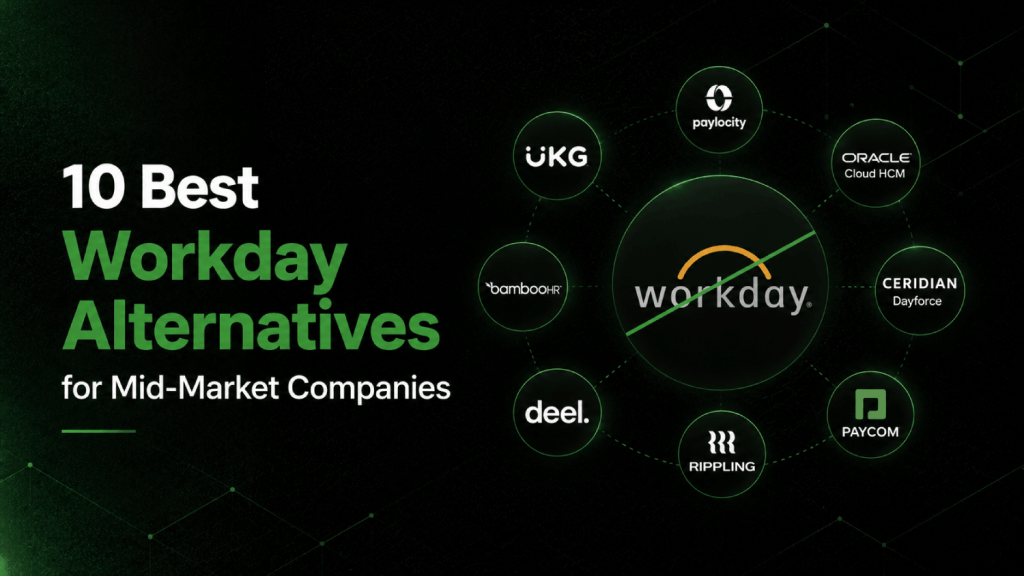
The best Workday alternatives for mid-market companies are UKG Pro, Rippling, Dayforce (formerly Ceridian), SAP SuccessFactors, BambooHR, HiBob, ADP Workforce Now, Paycor, Lattice, and Personio. Each solves a different version of the mid-market problem: too much complexity, too much cost, too little usability, or misaligned feature depth. The right pick depends on your headcount, geographic footprint, payroll complexity, and how much HR infrastructure you already have.
Why Do Mid-Market Companies Leave Workday?
Workday built its product for large enterprises with dedicated HRIS teams, long implementation budgets, and the appetite for a platform that touches every corner of the business. That profile describes a Fortune 500 HR operation. It does not describe a 400-person SaaS company that needs payroll running cleanly and managers to actually use their performance reviews.
The most common complaints mid-market buyers raise about Workday follow a consistent pattern. Implementation takes longer than expected , Gartner’s research on enterprise HCM deployments consistently cites a range of 12 to 18 months , and requires third-party consulting support that adds significantly to the total cost. According to pricing analysis from OutSail’s Workday pricing breakdown, Workday’s pricing structure is opaque and scales sharply with modules, integrations, and headcount, with total cost of ownership at mid-market scale typically reaching six figures or more when implementation and ongoing support are included. The configurability that enterprise buyers prize becomes a liability when your HR team is two people.
Usability is the second issue. Workday was redesigned in recent years, but mid-market HR leaders consistently report that manager self-service, mobile experience, and employee-facing interfaces still require training that leaner companies cannot deliver at scale. When adoption fails, the platform’s data quality degrades and analytics become unreliable.
The third issue is overkill. Workday’s HCM suite covers financial management, supply chain planning, and workforce planning at a depth that most mid-market HR teams will never touch. Paying for features you will not use in the next three years is a procurement mistake, not a safe bet.
How to Evaluate Workday Competitors for Mid-Market Fit
Before running a vendor selection process, align on which problem you are actually trying to solve. Mid-market buyers usually fall into one of four categories:
- Payroll-first buyers: Core payroll is broken or outsourced and needs to come in-house. ADP Workforce Now, Dayforce, and Paycor are built for this.
- People ops buyers: You have payroll covered and need performance, engagement, and manager tooling. HiBob, Lattice, and BambooHR serve this use case.
- Unified stack buyers: You want HR, IT, and finance on one platform to reduce your vendor count. Rippling is the clearest answer here.
- Global complexity buyers: You are managing employees in multiple countries and need compliance coverage alongside HCM depth. SAP SuccessFactors, Dayforce, and UKG Pro are the realistic options.
For a structured evaluation process, the HR software buying checklist with 75 vendor questions covers what to ask each of these vendors before signing a contract.
| Vendor | Best For | Typical Company Size | Pricing Model | Implementation Timeline |
|---|---|---|---|---|
| UKG Pro | Workforce management depth | 500 to 5,000 | Quote-based | 6 to 12 months |
| Rippling | HR + IT consolidation | 50 to 2,000 | Modular, from ~$8/user/mo (Rippling pricing page) | 2 to 8 weeks |
| Dayforce | Payroll complexity, global | 500 to 5,000 | Quote-based | 6 to 12 months |
| SAP SuccessFactors | Enterprise feature parity, SAP shops | 1,000+ | Quote-based | 9 to 18 months |
| BambooHR | SMB simplicity, first HRIS | 25 to 500 | Quote-based (per employee) | Days to weeks |
| HiBob | Culture-forward, modern UI | 100 to 2,000 | Quote-based | 4 to 10 weeks |
| ADP Workforce Now | Payroll reliability, compliance | 50 to 1,000 | Quote-based | 4 to 12 weeks |
| Paycor | Mid-market payroll + HR | 50 to 1,000 | Quote-based | 4 to 8 weeks |
| Lattice | Performance + engagement | 100 to 2,000 | From $11/person/mo (Lattice pricing page) | 2 to 6 weeks |
| Personio | European mid-market HR | 50 to 2,000 | Quote-based | 4 to 8 weeks |
1. UKG Pro: The Closest Feature-for-Feature Workday Competitor
UKG Pro competes with Workday most directly on depth. The platform covers core HR, payroll, talent management, workforce management, and analytics in a single suite. For mid-market companies in the 500 to 2,000 employee range, UKG Pro delivers enterprise-grade HCM without the Workday implementation overhead.
UKG’s workforce management heritage (from the Kronos side of the 2020 UKG merger) gives it a genuine advantage in scheduling, time tracking, and labor compliance. If you manage hourly workers, shift-based operations, or have complex overtime rules, UKG Pro handles those scenarios better than most mid-market platforms. The tradeoff: it is not cheap, and its interface carries some of the legacy complexity you might expect from a platform with deep roots in enterprise time-and-attendance software.
Workday vs UKG: Both are quote-based. Gartner lists UKG Pro among the top alternatives to Workday HCM. For workforce management depth, UKG Pro wins. For global financial management integration, Workday retains the advantage.
2. Rippling: Best for Consolidating HR and IT Into One Platform
Rippling approaches HCM from a different angle than everyone else on this list. Instead of starting with payroll or performance, it starts with identity: one employee record drives HR, IT, and finance workflows simultaneously. When you hire someone, Rippling can provision their laptop, create their email, add them to payroll, enroll them in benefits, and set their app permissions in a single flow.
For technology companies and distributed teams where IT and HR overlap constantly, this is not a gimmick. It eliminates a real category of administrative work. Rippling’s modular pricing means you can start with core HRIS and payroll and add modules as you grow. According to Rippling’s public pricing page, the platform starts at around $8 per user per month for the workforce platform, with modules priced separately.
The limitation is depth. Rippling is excellent at breadth across HR and IT but does not match UKG Pro or Dayforce for workforce management complexity. If you have union rules, complex labor scheduling, or intricate payroll calculations, Rippling may run short. For a 200-person tech company that wants to cut their vendor count from six to two, it is often the right answer.
3. Dayforce (Formerly Ceridian): Best for Payroll Complexity at Scale
Dayforce is the most credible alternative to Workday for companies where payroll is genuinely complex. Real-time payroll processing (calculating pay as time data flows in rather than in batch at period end) is a feature no other platform on this list matches. For companies with complex overtime calculations, multi-state taxation, or high employee-count industries like healthcare and manufacturing, that architecture matters.
Dayforce covers the full HCM suite: workforce management, talent acquisition, performance, and benefits. Gartner ranks it among the top Workday alternatives. Implementation is not fast, typically 6 to 12 months for a full deployment, and it is priced at a level comparable to Workday for similar module coverage. The differentiation is payroll integrity, not cost savings.
If you are leaving Workday specifically because of payroll accuracy problems or complex multi-jurisdiction compliance, Dayforce should be on your shortlist.
4. SAP SuccessFactors: For Organizations Already Running SAP
SAP SuccessFactors is a direct Workday competitor at the enterprise level and the platform Gartner consistently lists first among Workday alternatives. For mid-market companies that already run SAP ERP for finance or supply chain, SuccessFactors removes integration complexity that would exist with any other HCM vendor.
For companies outside the SAP environment, the value proposition weakens. SuccessFactors has a reputation for a less intuitive user interface than Workday, and implementation timelines can match or exceed Workday’s. It is not simpler or cheaper to run. It is a competitive alternative for organizations where SAP integration is the deciding factor, not a mid-market simplification play.
If your company is not already running SAP and you are trying to move away from Workday’s complexity, SuccessFactors will likely recreate the same problems.
5. BambooHR: The Simplest Path to Core HR for Smaller Mid-Market Companies
BambooHR is the most-cited Workday alternative for companies at the smaller end of mid-market, typically 25 to 500 employees. It does less than Workday by design. Core HR records, onboarding, time tracking, performance reviews, and a basic ATS cover what most companies at this size actually need.
BambooHR’s strongest asset is adoption. The interface is clean enough that employees and managers actually use it without training. For HR teams of one or two people who cannot manage a complex platform, that adoption rate is the most important metric. Implementation takes days to weeks, not months.
The ceiling is real. BambooHR does not handle complex payroll natively in the same depth as ADP or Dayforce. Its analytics are adequate for basic reporting but thin compared to Workday’s People Analytics or dedicated platforms. If you are at 600 employees and growing, you may outgrow BambooHR within two to three years. For companies at 100 to 300 employees that want clean HR operations without enterprise overhead, it is the easiest choice to defend.
6. HiBob: Best for Culture-Forward Mid-Market Teams
HiBob (branded as Bob) took a specific design bet when it launched: make the HRIS the platform employees actually want to open, not just the system HR uses to store records. The result is an interface that looks more like a modern consumer app than traditional enterprise HR software, with org charts, employee profiles, surveys, and compensation tools presented in a way that drives actual adoption.
HiBob covers core HR, onboarding, performance, compensation management, and workforce planning. It integrates with Greenhouse, Lever, and other ATS tools. For companies where culture, engagement, and employer brand are genuine priorities, HiBob outperforms most alternatives on the employee experience side.
The tradeoff is payroll. HiBob relies on integrations for payroll rather than native processing in most markets, which adds complexity for companies that want a single-vendor solution. It is also primarily positioned for mid-market companies under 2,000 employees; the depth of reporting and customization at larger scale is not where HiBob competes.
7. ADP Workforce Now: Best for Payroll Reliability and Compliance
ADP Workforce Now is the dominant payroll platform for mid-market US companies, and that dominance is earned by reliability. ADP processes payroll for a significant portion of the US workforce. The compliance infrastructure, tax filing, and benefits administration built into Workforce Now reflect decades of operational investment.
The critique of ADP Workforce Now is not payroll accuracy; it is the HR and talent modules built around the payroll core. Performance management, recruiting, and learning in Workforce Now are functional but rarely win head-to-head comparisons with dedicated talent platforms. The platform’s interface has improved but still carries the weight of its legacy architecture.
ADP is a strong choice when payroll and compliance are the primary concern and you are comfortable using point solutions for recruiting or performance. It is not the right pick if user experience and manager adoption are your primary goals.
8. Paycor: The Mid-Market Payroll and HR Platform Worth Considering
Paycor sits in a segment often overlooked in enterprise-focused discussions: the 50 to 1,000 employee mid-market that needs more than BambooHR but less than Workday. Paycor covers payroll, benefits, time tracking, recruiting, onboarding, and performance in a single platform, with pricing typically more accessible than ADP Workforce Now at comparable feature sets.
Paycor’s analytics product has received attention for giving mid-market HR leaders access to workforce data that previously required dedicated analytics tools. The platform is US-focused, so for companies with international headcount, Paycor is not the answer.
For a US-based company in the 100 to 500 employee range that wants unified payroll and HR without enterprise pricing, Paycor competes directly with ADP Workforce Now and often wins on implementation speed and per-employee cost.
9. Lattice: Best When Performance and Engagement Are the Priority
Lattice is not a full HCM replacement for Workday. It does not process payroll or manage core HR records in the same way. What Lattice does exceptionally well is the talent management layer: performance reviews, OKRs, 1:1 management, engagement surveys, and compensation benchmarking tied together in a coherent workflow.
According to Lattice’s public pricing page, the platform starts at $11 per person per month for performance management, with additional modules for engagement and compensation priced separately. For companies that have stable payroll and HRIS infrastructure but need to upgrade their performance and people management operations, Lattice is often the most cost-effective path.
Lattice added an HRIS product, which means it is moving toward being a more complete platform. For buyers considering Workday primarily for talent management rather than core HR, Lattice plus a payroll provider is worth evaluating as a two-vendor alternative. Companies looking at broader people analytics capability should also consider the best AI people analytics platforms that integrate alongside tools like Lattice.
10. Personio: Best Workday Alternative for European Mid-Market Companies
Personio is the dominant HR platform for mid-market companies in Germany, Austria, Switzerland, and the broader European market. It covers core HR, recruiting, payroll (in select markets), onboarding, and performance management with European compliance built into the product rather than bolted on.
For US-headquartered companies with significant European headcount, Personio handles the GDPR-aware data model and local labor law nuances that US-built platforms often manage awkwardly through configuration. For companies headquartered in Europe, Personio is frequently the clearest path away from Workday’s overhead without sacrificing compliance coverage.
Personio’s limitation is geographic. It does not extend natively into the US or Asian markets at the same compliance depth. For a purely European or EMEA-focused business, it is a strong first-choice alternative. For a global business, it works best as a regional instance alongside another platform.
What Does Workday Actually Cost for a Mid-Market Company?
Workday does not publish pricing. According to analysis from OutSail’s Workday pricing breakdown, total cost of ownership for Workday at mid-market scale typically includes per-employee subscription fees, implementation costs that can run into six figures or more, and ongoing consulting support for configuration and upgrades. The eLearning Industry’s Workday HCM pricing analysis notes that quotes vary significantly by module set and company size.
The operational reality is that Workday’s total cost is not just the subscription. Mid-market companies frequently discover that they need external implementation partners to configure the system and ongoing support to manage it. For companies considering this, reviewing the options among HRIS implementation partners for mid-market companies gives a realistic picture of what post-contract costs look like across these platforms.
For comparison: Rippling starts at approximately $8 per user per month according to its public pricing page. Lattice starts at $11 per person per month according to its public pricing page. BambooHR, ADP Workforce Now, Paycor, UKG Pro, Dayforce, HiBob, SAP SuccessFactors, and Personio are all quote-based, and actual pricing depends on headcount, modules, and contract length. Getting a real comparison requires a formal RFP process, but the directional gap between Workday and these alternatives at mid-market scale is meaningful.
Which Workday Alternative Is Best for Your Specific Situation?
The answer depends on which problem you are solving, not which platform has the longest feature list.
If your company has complex workforce scheduling, time tracking, or hourly labor: evaluate UKG Pro first. If you run a distributed tech company and want HR plus IT in one system: Rippling is the most coherent answer. If payroll accuracy across multiple states or jurisdictions is the critical requirement: Dayforce or ADP Workforce Now. If you are under 400 employees and need clean, usable HR operations fast: BambooHR or HiBob. If you are in Europe: Personio unless you have significant US headcount. If performance management and people strategy are the core problem and payroll is handled: Lattice.
One thing mid-market buyers consistently underestimate is implementation risk. Choosing a platform that takes 14 months to deploy means 14 months of parallel systems, data migration uncertainty, and team distraction. For companies evaluating implementation complexity across these options, looking at dedicated Workday consulting firms and their guidance on what a realistic mid-market deployment involves sets a useful baseline for comparison.
Frequently Asked Questions
What is better than Workday for a 300-person company?
For a 300-person company, BambooHR, HiBob, or Rippling are more practical than Workday. All three offer faster implementation, lower total cost, and better adoption rates at that scale. Workday’s depth becomes valuable above roughly 1,500 to 2,000 employees and only when you have dedicated HR operations staff to manage it. Below that threshold, the complexity is a liability, not an asset.
Is ADP or Workday more expensive?
Workday is generally more expensive for mid-market companies than ADP Workforce Now, particularly when total cost of ownership includes implementation and ongoing consulting. ADP Workforce Now is priced for the mid-market segment and does not require the same level of external configuration support. Both are quote-based, so direct comparison requires getting proposals from both vendors for identical scope.
What systems does Workday typically replace?
Workday most commonly replaces legacy HRIS platforms like PeopleSoft (Oracle), SAP ERP HCM, ADP Enterprise, and older on-premise HR systems. In mid-market, it often replaces a combination of BambooHR or a basic HRIS plus a separate payroll provider, when a company decides to consolidate onto a single enterprise platform. The reverse is also common: companies that implemented Workday too early replacing it with BambooHR, Rippling, or HiBob.
Can you implement a Workday alternative without a consultant?
BambooHR and Rippling are designed for self-service implementation and most companies in their target size range deploy without dedicated consultants. HiBob and Lattice similarly offer guided onboarding that does not require external partners. UKG Pro, Dayforce, SAP SuccessFactors, and ADP Workforce Now at mid-to-large scale almost always benefit from implementation partner support, particularly for payroll migration and integration configuration.
How long does it take to implement a Workday alternative?
Implementation timelines vary by platform and scope. Rippling can be operational in two to eight weeks. BambooHR and Lattice typically take days to a few weeks for core modules. HiBob averages four to ten weeks. ADP Workforce Now and Paycor run four to twelve weeks for full deployment. UKG Pro and Dayforce typically require six to twelve months for a complete mid-market implementation. SAP SuccessFactors can take nine to eighteen months at enterprise scale.
Is Workday overkill for a mid-market company?
For most companies under 1,500 employees, yes. Workday’s configurability, implementation requirements, and total cost are calibrated for large enterprises with dedicated HR technology teams. Mid-market companies typically get faster time to value, higher adoption, and lower total cost from platforms built for their size. The exceptions are mid-market companies with genuinely complex operations: multi-country payroll, union labor, or heavy workforce management requirements.
What is the easiest Workday alternative to implement?
Rippling and BambooHR are consistently the fastest to implement among mainstream Workday alternatives. Rippling’s structured onboarding and BambooHR’s simple data model mean most mid-market companies can be operational in under a month. Lattice is similarly fast for the talent management layer. If speed to deployment is your primary constraint, these three should lead your evaluation.
Do any Workday alternatives include AI features?
Most platforms on this list have added AI-assisted features in recruiting, performance, and analytics. Rippling, Lattice, HiBob, and UKG Pro have all announced or shipped AI features in talent workflows. For a detailed look at what those capabilities mean in practice, the AI people analytics platform comparison covers how mid-market tools stack up on workforce intelligence. A separate article covers the Workday AI versus SAP Joule versus Oracle AI comparison for enterprise buyers.
The Decision Most Mid-Market Buyers Get Wrong
Most mid-market companies that regret their HCM decision did not choose the wrong vendor. They chose a vendor that was right for the company they planned to be in three years rather than the company they are today. Workday is aspirational for many mid-market HR leaders because it signals operational maturity and enterprise credibility. But a platform you cannot fully deploy, that your managers will not use, and that requires a consultant to configure every workflow is not a sign of maturity. It is a procurement mistake wearing an enterprise badge.
The practical framework: if you have fewer than 1,000 employees, a dedicated HR technology team does not exist, and your payroll is not extraordinarily complex, a tier below Workday will almost certainly serve you better. That tier includes UKG Pro for workforce management depth, Rippling for consolidation, Dayforce for payroll complexity, HiBob for employee experience, and BambooHR for simplicity. These are not compromise choices. They are the right tools for the job.
Pick the platform your team will actually use. A well-adopted BambooHR generates better HR data, better manager behavior, and better decisions than a poorly adopted Workday deployment. Platform selection is not about brand prestige. It is about what runs reliably at your scale, in your hands, with your team.