
5 Best Job Posting Data Providers for Recruiting Platforms and Agencies

TLDR
- Job posting data quality varies far more than vendors admit. Freshness, deduplication logic, expiry handling, and redistribution rights determine whether a feed is usable in a recruiting product.
- Coresignal and LinkUp serve fundamentally different use cases: Coresignal optimizes for breadth and historical depth, LinkUp for direct-source accuracy on active US postings.
- People Data Labs is primarily a candidate profile API. Its job posting layer is secondary. Buyers building posting-centric feeds should treat PDL as a complement, not a primary source.
- Deduplication is the silent killer of feed quality. A provider claiming 100 million postings may deliver 40 million unique jobs if they do not normalize aggressively across syndicated boards.
- Redistribution rights are the legal tripwire most product teams miss. Read the licensing terms before you build anything on top of the feed.
The five best job postings data providers for recruiting platforms and agencies are Coresignal, People Data Labs, JobsPikr, LinkUp, and Canaria. Each handles freshness, deduplication, historical coverage, and redistribution rights differently. Your choice depends on whether you need global breadth, direct-source accuracy, historical depth for market intelligence, or compliant redistribution inside a commercial product.
Why Most Buyers Pick the Wrong Job Posting Data Provider
The default assumption when buying a job data API is that coverage numbers tell the whole story. They do not. A feed with 150 million postings can deliver worse signal than one with 30 million if the larger set is filled with duplicates pulled from job board syndicates, expired listings that were never retired, and reposts treated as fresh vacancies.
The real evaluation axes are freshness (how quickly postings enter and exit the feed), deduplication (whether the same job appearing on Indeed, LinkedIn, ZipRecruiter, and the company’s own site is counted once or four times), expiry logic (whether closed roles are removed or left to rot), historical depth (how far back you can query for time-series analysis), and redistribution rights (what your contract actually permits you to do with the data downstream).
Recruiting product builders and agencies also need to separate two data types that vendors sometimes conflate: posted vacancy data (what employers are hiring for) and candidate personal profiles (who is available). Talent intelligence platforms consume both. But if you are building a job matching engine, a market intelligence dashboard, or a sourcing product, mixing these types at the data layer creates compliance and quality problems. Know which one you are buying before you sign anything.
What Dimensions Actually Separate Job Postings Data Providers?
Before the vendor-by-vendor breakdown, here is the framework buyers should apply consistently across any shortlist.
Freshness and crawl frequency
Freshness measures the lag between when an employer posts a job and when it appears in your feed. Daily crawls are the baseline. Some providers refresh high-volume sources multiple times per day , for example, a provider might crawl Indeed three times daily while processing smaller niche boards once per week. Others batch-process weekly, which is fine for trend analysis and useless for real-time job matching. Ask for the average and median crawl cadence by source type, not just the headline figure. Get specific numbers per source tier, not a blanket claim.
Deduplication methodology
A single job posting can appear on a company careers page, two or three job boards, an aggregator, and multiple niche sites simultaneously. Without aggressive normalization, your feed inflates artificially. Good deduplication assigns a canonical ID to a job, maps all downstream appearances to that ID, and presents one record. Bad deduplication counts each URL as a posting. Ask vendors how they define a single job and what percentage of their raw crawl volume gets deduplicated out.
Job expiry and close-date handling
Expired postings that are not removed poison match quality and generate candidate complaints when a job alert sends someone to a closed role. Providers handle this in three ways: structured expiry signals from employer ATS integrations, inferred expiry based on when a posting disappears from source pages, and time-based TTL rules applied as a fallback. The best feeds use all three in combination.
Historical depth
Depth matters for two use cases: labor market analytics (what were hiring trends for software engineers in Austin twelve months ago) and model training (building prediction models requires years of posting history). Providers vary from a few months of rolling history to multi-year archives. If you need historical data, confirm it is queryable in the same schema as live data, not locked in flat files you have to process separately.
Geographic and sector coverage
US coverage is table stakes. The gaps appear in non-English markets, SME job boards, government portals, and sector-specific sources like healthcare, logistics, and skilled trades. Map your product’s user base before assuming global coverage is uniform.
Redistribution and licensing rights
This is where most product teams get surprised. Many job data licenses permit internal analytics but prohibit redistribution inside a commercial product or SaaS application. If you are building a product that surfaces job postings to end users, your contract must explicitly permit sublicensing or redistribution. Assume nothing. Get it in writing before you build.
| Provider | Primary Use Case | Freshness | Deduplication | Historical Depth | Redistribution |
|---|---|---|---|---|---|
| Coresignal | Market intelligence, talent analytics | Daily to weekly by source | Strong normalization | Multi-year archive | Negotiable per license |
| People Data Labs | Candidate profiles + supplemental job data | Variable | Moderate | Limited | Permitted with restrictions |
| JobsPikr | Custom feeds, job board infrastructure | Daily | Configurable | Rolling archive | Commercial redistribution available |
| LinkUp | Verified active postings, US-heavy | Daily from employer sources | Strong, direct-source | Multi-year | License-dependent |
| Canaria | Enriched job data, EU compliance | Near-daily | Entity-level matching | Growing archive | API redistribution available |
1. Coresignal: Best for Market Intelligence and Talent Analytics Platforms
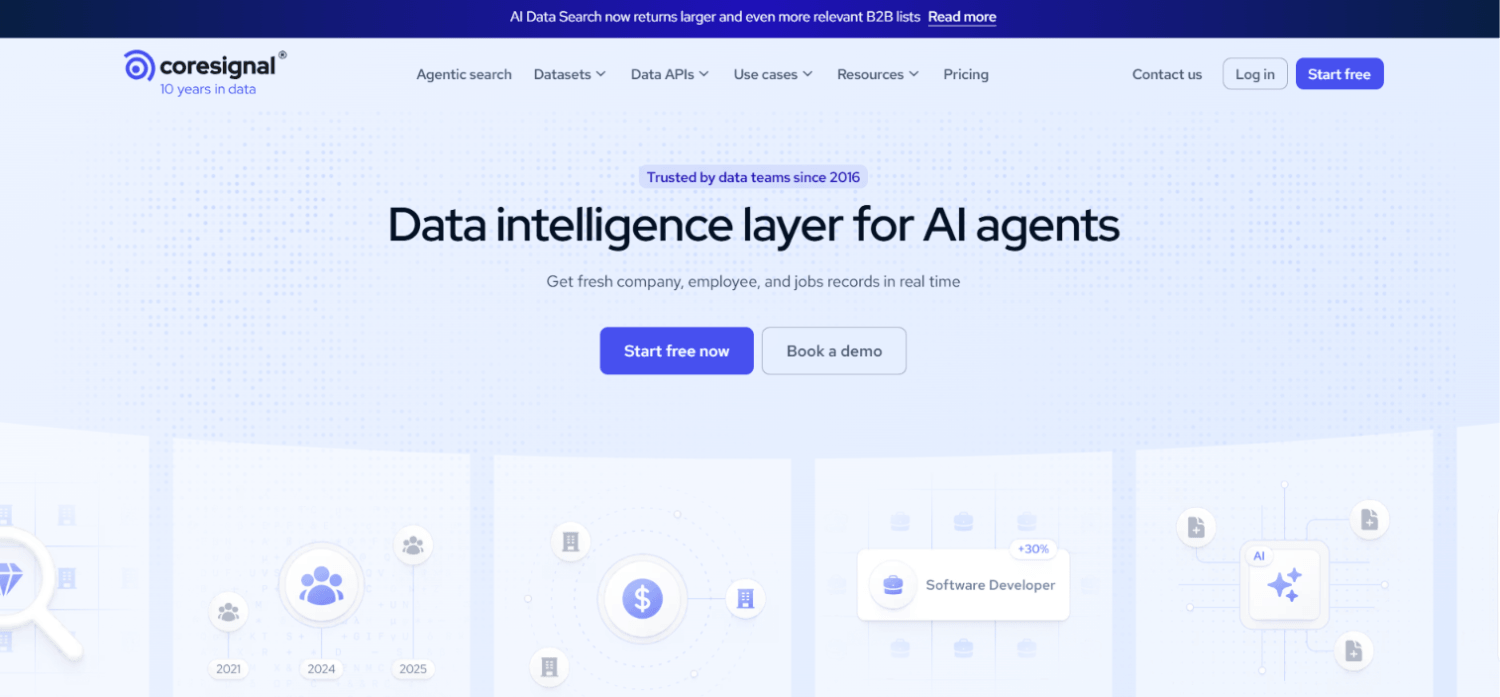
Coresignal collects job postings as part of a broader web data infrastructure that also covers company records and professional profile signals. Its job data product is strongest when you need wide geographic coverage, multi-year historical archives, and the ability to cross-reference posting data with company-level firmographics.
The crawl network spans a significant number of public sources globally. Coresignal normalizes postings into a structured schema that includes employer entity resolution, meaning a posting from Amazon’s careers page and the same role syndicated to a third-party board is mapped to the same employer record. That entity resolution is what makes Coresignal genuinely useful for workforce planning analytics rather than just job board replication.
Where Coresignal is strong
Historical depth is the clearest advantage. If you are building a product that needs to show hiring trend lines, skill demand shifts over time, or competitive intelligence on a company’s headcount growth, Coresignal’s multi-year archive is one of the few feeds that supports this without requiring you to stitch together multiple sources. The data is available via API and as bulk datasets, and Coresignal is transparent about its raw versus deduplicated volumes.
Freshness on major sources runs daily; long-tail or regional sources may refresh less frequently. This cadence is adequate for market intelligence workloads but not optimized for real-time job alerts. Buyers building candidate-facing products with same-day posting alerts should verify Coresignal’s crawl schedule for their specific priority sources against the SLA their users expect.
Licensing and redistribution
Coresignal operates on a negotiated licensing model. Redistribution terms vary by contract, and commercial redistribution inside a third-party product typically requires a specific clause. Pricing is quote-based, with no publicly listed tiers. Buyers should clarify scope before signing, particularly on whether their use case involves resurfacing Coresignal job records to end users of their own product.
Who should evaluate Coresignal
Talent intelligence vendors, labor market analytics platforms, and recruiting agencies that need historical posting data to power competitive benchmarking. If your primary need is real-time active vacancy matching for job seekers or candidates, there are better-matched options in this list. If you are building something adjacent to what the leading AI people analytics platforms consume as a data layer, Coresignal belongs on your shortlist.
2. People Data Labs: Best When You Need Profiles and Job Data Together

People Data Labs (PDL) is primarily a person and company data API. Its job posting dataset is real and queryable, but it is a secondary product relative to its professional profile coverage.
The distinction matters enormously. PDL’s core value proposition is its enriched candidate profile layer: work history, education, contact signals, and company affiliations assembled from public web sources. If you are building an AI sourcing product and you need to augment job postings data with information about who has done similar roles at similar companies, PDL provides that connection in a single API.
Where PDL is strong
The person-to-posting relationship is PDL’s advantage. If your product needs to answer questions like “who previously held a role with these characteristics at companies of this type in this geography,” PDL can answer that in ways that pure job posting feeds cannot. The company data layer is also well-structured, which helps with employer-side enrichment.
PDL’s job posting freshness and deduplication are adequate but not industry-leading. The platform is better suited as a complementary data source alongside a higher-frequency posting feed rather than the sole source of vacancy data. For recruiting product builders who need clean, current postings as the primary content layer of their product, relying solely on PDL introduces risk.
Important distinction: posted vacancy data versus candidate profiles
PDL handles both, but the data types carry different compliance implications. Candidate profile data sourced from public web profiles carries GDPR, CCPA, and consent considerations that posted vacancy data does not. If your product consumes both types from PDL, your privacy and data governance review must cover both categories separately. Do not assume a single DPA covers all use cases.
Licensing and redistribution
PDL permits redistribution in commercial products with contractual restrictions. The API is available at tiered pricing that PDL publishes publicly for some tiers , starter and growth plans are listed on the PDL pricing page, with enterprise volume pricing negotiated directly. Buyers should review PDL’s terms of service for redistribution conditions specific to their use case before building any downstream product on the feed.
Who should evaluate PDL
AI sourcing tools, recruiting CRMs, and talent intelligence products that need to combine job context with candidate profile enrichment. It also fits agencies running data-driven talent mapping where you need to cross-reference demand signals (what is being hired for) with supply signals (who exists with relevant skills). It is a poor fit as a standalone job posting feed for a job board or matching engine.
3. JobsPikr: Best for Custom Feed Delivery and Job Board Infrastructure

JobsPikr, built on the PromptCloud web data infrastructure, offers one of the more configurable job data feeds available to product builders. The core pitch is a managed crawling service: you define the sources, geographies, job categories, and delivery format, and JobsPikr handles the extraction, normalization, and delivery pipeline.
That configurability is its sharpest differentiator. Rather than receiving a standard global feed and filtering it down, buyers can specify exactly what they need at the source level. For a recruiting platform serving a niche market (say, engineering roles in the Midwest US, or healthcare positions across three countries), this targeted approach produces a cleaner feed with less noise than a general global crawl would.
Freshness and deduplication
JobsPikr targets daily crawl cycles for most configured sources, with high-priority sources crawled more frequently on request. Deduplication is configurable, which is a double-edged feature. Buyers who understand their deduplication requirements and can specify them get clean data. Buyers who leave deduplication defaults in place without reviewing the logic may find duplicate records in the feed. This is a product that rewards buyers who know what they want technically.
Job expiry handling relies on detecting when a posting disappears from its source page. There is no proprietary ATS integration layer to receive structured close signals, so expiry is inferred rather than explicit. For most use cases this is acceptable. For a product where expired listings would seriously harm user experience, test the expiry lag during your sample evaluation.
Historical depth
JobsPikr maintains a rolling archive. The depth available depends on how long a customer’s specific feed configuration has been running. For buyers starting fresh, historical depth on custom configurations is limited until the feed has run long enough to accumulate data. Buyers needing multi-year archives on day one should look at Coresignal or LinkUp for that layer.
Licensing and redistribution
JobsPikr explicitly supports commercial redistribution use cases, which is one reason it appears frequently in job board and aggregator infrastructure discussions. The licensing model is structured to accommodate product builders who will surface job data to their own end users. Pricing is available through a request-sample workflow on the JobsPikr site, with plans scaled by volume and source complexity , the vendor does not publish a standard rate card publicly.
Who should evaluate JobsPikr
Job board operators, niche recruiting platforms serving defined geographies or verticals, and agencies building custom data pipelines for clients. The configurability suits buyers who have clear data specifications. It is less suited to buyers who want a pre-built global feed with minimal setup, since the value of the product is in its customization rather than a commodity data layer.
4. LinkUp: Best for Verified Active Postings in the US Market

LinkUp occupies a distinct position in this market because its sourcing methodology is deliberately different from web crawlers and job board aggregators. LinkUp collects job postings directly from employer career sites rather than from syndicated job boards. The practical result is a feed where every posting is traceable to an employer’s own ATS or careers page, which has two significant implications.
First, the data is genuinely deduplicated at the source. A posting appearing on LinkUp represents one job at one employer. There is no board syndication inflating the count. Second, job expiry is far more accurate. When an employer removes or closes a role on their careers page, LinkUp detects that removal directly, rather than waiting for a board to propagate the close signal. This makes LinkUp’s active posting counts more reliable than broad aggregators for understanding real open vacancy volume.
Coverage profile
LinkUp’s direct-source methodology is strongest in the US. Coverage of international markets depends on employer career site availability in those regions, which means US-headquartered or US-heavy hiring companies are well represented while smaller international employers may not appear. Buyers building global products should request a coverage breakdown by country and employer size before committing.
The feed skews toward companies large enough to maintain an independent careers page or branded ATS instance. Very small employers who post exclusively to job boards and never maintain their own careers site will be underrepresented. For products serving SME hiring markets, this is a material gap.
Historical depth and analytics use
LinkUp has maintained its direct-source feed for over a decade, which gives it genuine multi-year historical depth on US employer hiring patterns. This makes it one of the stronger options for labor market analytics and economic research applications where you need long time-series data with high confidence in uniqueness. Several labor market research organizations and economic forecasters use LinkUp data precisely because its deduplication methodology makes trend data more reliable than aggregator feeds.
Licensing and redistribution
LinkUp operates a licensing model. Redistribution terms are negotiated per contract. The company serves both data analytics customers and product builders, so redistribution arrangements exist, but buyers need to specify their use case clearly during contracting. Pricing is quote-based, with no publicly listed tiers.
Who should evaluate LinkUp
US-focused recruiting platforms, labor market analytics vendors, economic research products, and workforce planning tools that need high-confidence active vacancy data rather than raw volume. If your product’s accuracy depends on knowing that a job is genuinely still open at the moment a candidate views it, LinkUp’s direct-source methodology reduces that error rate relative to aggregated feeds. Teams building AI sourcing tools that need to match candidates to verified open roles will find LinkUp’s active posting reliability particularly valuable.
5. Canaria: Best for Enriched Job Data With EU Compliance Requirements

Canaria is a newer entrant relative to Coresignal and LinkUp, and its differentiation sits at the intersection of data enrichment and compliance-forward architecture. The product is built to serve recruiting technology companies that need structured job data with entity-level employer enrichment and need to operate confidently under GDPR and evolving EU AI Act requirements.
Where most job data APIs deliver a posting as a structured record (title, location, date, description), Canaria adds employer-side enrichment: company size, industry classification, funding stage where available, and technology signals inferred from the job description itself. For talent intelligence and matching products, that enrichment layer reduces the amount of downstream processing needed to make a raw posting usable.
Freshness and deduplication
Canaria targets near-daily refresh cycles across its covered sources, with major European job boards and employer career sites crawled daily and smaller regional sources on a 48-to-72-hour cycle. The deduplication approach uses entity-level employer matching, meaning postings are grouped at the company level before URL-level deduplication, which catches cases where the same employer posts from multiple domains or career site subdomains. This is a methodologically sound approach that reduces false duplicate removal while still catching genuine syndication duplication.
The active archive is growing. Canaria is more recent than Coresignal or LinkUp, so buyers requiring multi-year historical depth should request specifics on what time range is available before building a historical analytics use case around it.
EU compliance and data governance
Canaria’s compliance posture is one of its clearer selling points for European market buyers. The product is designed with GDPR data residency and processing transparency in mind from the architecture up, rather than as a retrofit. For recruiting platforms operating in Germany, the Netherlands, or other EU markets where data processing practices face close regulatory scrutiny, that architectural posture reduces the compliance burden during vendor due diligence.
Given the EU AI Act’s emerging requirements on AI systems used in hiring decisions, the downstream governance of job data is becoming a live concern for product builders, not just an academic one. Canaria’s documentation on data provenance and processing lineage gives compliance teams more to work with than most job data API vendors provide. If your product team or legal team uses an AI HR vendor evaluation checklist, Canaria scores well on the data governance questions.
Redistribution and API access
Canaria supports API redistribution for commercial products. The licensing model is designed for product builders rather than only internal analytics consumers. Pricing is quote-based and varies by volume and geographic scope , no standard rate card is published publicly.
Who should evaluate Canaria
Recruiting technology companies building EU-facing products, particularly those in Germany, the Netherlands, or broader European markets where GDPR compliance and AI Act readiness are purchasing criteria rather than nice-to-haves. Also relevant for product builders who want pre-enriched job data and do not want to run their own employer entity resolution pipeline. Buyers who are primarily US-focused and do not have compliance requirements justifying a newer provider should weigh Canaria against the more established coverage depth of LinkUp and Coresignal.
How to Run a Job Posting Data Feed Evaluation Before You Sign
Buying on marketing materials gets product teams burned. Every provider on this list will send you an impressive deck. The only evaluation that matters is a structured sample test against your actual use case data.
Step 1: Define your freshness SLA
Before requesting samples, write down the acceptable lag between a job being posted and appearing in your feed. If your product sends daily job alerts to candidates, a 48-hour lag is probably acceptable. If you are building a real-time matching engine, it is not. Map this requirement to the crawl cadence each vendor quotes for your priority source categories , and ask for specific numbers per source tier, not an averaged claim across the whole feed.
Step 2: Request a deduplicated sample on a known set
Pick 20 to 30 employers you know well and check whether the vendor’s feed shows one record per open role or inflated counts from board syndication. This test is more revealing than any volume claim in a vendor pitch deck. A provider with honest deduplication will welcome the test. One that deflects it is telling you something.
Step 3: Test expiry against closed roles
Pull a sample of postings from 60 days ago and check whether roles you know are now closed are flagged correctly in the feed or still showing as active. For any provider using only inferred expiry (no ATS integrations), this test often surfaces a meaningful lag. Document the expiry error rate by source type, since it varies significantly between providers.
Step 4: Query the historical archive schema consistency
If historical depth is on your requirements list, confirm that the archive data uses the same field schema as the live feed. Some providers maintain archives as flat file dumps with different normalization than their API output. That inconsistency creates engineering work downstream that buyers often discover after signing.
Step 5: Get redistribution terms in writing before the commercial discussion
Ask for the standard redistribution clause before price negotiations start. Vendors occasionally present redistribution restrictions after pricing is agreed, which creates awkward renegotiations. Knowing the default terms upfront lets you factor licensing scope into your cost comparison accurately. Teams building products should review their vendor contract process alongside their broader HR software buying checklist process for data supplier agreements.
Frequently Asked Questions
What is a job postings data provider and how is it different from a job board?
A job board is a consumer-facing platform where employers post roles and candidates apply. A job postings data provider aggregates vacancy data from across multiple sources (employer career sites, job boards, ATS platforms) and delivers it as a structured API or data feed for third-party products to consume. The data provider is infrastructure for building products. A job board is the end product itself. Recruiting platforms, analytics tools, and sourcing products buy from data providers; candidates use job boards.
How do I evaluate job data freshness before signing a contract?
Request a sample dataset and cross-reference postings against the original employer career pages for a set of companies you can verify directly. Check the date stamps against your own monitoring of those employer sites. Ask the vendor to specify crawl frequency by source type , not just an overall average , and push for specific numbers: how often do they crawl major sources like Indeed versus smaller niche boards? Also test whether postings that disappeared from employer sites in the past two weeks are still appearing as active in the vendor’s feed.
What is the difference between job posting deduplication and job expiry handling?
Deduplication is the process of recognizing that the same job posted across multiple platforms is one job, not several. It is a spatial problem: collapsing multiple copies of the same posting into a single canonical record. Expiry handling is a temporal problem: recognizing that a job that existed yesterday is now closed and removing or flagging it accordingly. Both are required for feed quality. A feed that deduplicates well but handles expiry poorly will show accurate counts today and stale data tomorrow.
Can I redistribute job posting data inside my recruiting software product?
It depends entirely on the vendor contract. Most job data providers permit internal analytics use by default. Redistribution inside a commercial product delivered to third-party users requires an explicit redistribution or sublicensing clause. JobsPikr and Canaria both structure their licensing to support commercial redistribution use cases. LinkUp and Coresignal permit it through negotiated terms. People Data Labs permits redistribution with contractual restrictions on scope. Never assume your standard data API agreement covers product redistribution. Get the specific clause in writing.
How much historical job data do I need for a recruiting analytics product?
For trend analysis and market intelligence dashboards, at least 12 to 24 months of consistent historical data gives enough signal to show seasonal patterns and hiring velocity trends. For machine learning model training, deeper archives (three to five years) improve model generalizability significantly. For real-time job matching or sourcing tools, historical depth is largely irrelevant to the core product function. Match your historical requirement to your actual use case before paying a premium for archive depth you will not query.
Is People Data Labs a job posting data provider or a candidate data provider?
Both, but the emphasis matters. People Data Labs is primarily a professional identity and enrichment platform. Its person API covers work histories, education, contact signals, and company affiliations. Its job posting dataset exists and is queryable, but it is not the core product. Buyers who need a high-volume, high-freshness job posting feed as their primary data source should treat PDL as a complement to a dedicated job postings data provider, not a replacement for one.
What geographic coverage gaps should I expect from job posting data providers?
US coverage is strongest across all five providers reviewed here. EU coverage varies: Canaria has the deepest EU-specific focus, while Coresignal offers broad multilingual coverage with varying depth by country. LinkUp’s direct-source methodology means coverage depends on whether employers in a given market maintain English-language or natively indexed career pages. Asia-Pacific, Latin America, and the Middle East are typically the weakest regions across most job data providers. Request a country-level coverage breakdown as part of your sample evaluation if international markets are material to your product.
How do job posting data feeds relate to talent intelligence platforms?
Talent intelligence platforms typically consume job posting data as one of several inputs, alongside candidate profile data, skills taxonomies, and internal workforce records. The job posting feed provides external labor market demand signals. Platforms like Eightfold, Beamery, and Gloat use external posting data to infer skill demand trends, benchmark internal role structures, and identify competitive hiring patterns. If you are evaluating both a job data feed and a talent intelligence platform, check whether the platform’s existing data partnerships already cover your use case before licensing a separate feed. The criteria for choosing a talent intelligence platform include data coverage questions that overlap directly with job feed evaluation.
Which Job Posting Data Provider Should You Choose?
The vendors in this list serve genuinely different product and use-case profiles. LinkUp wins on verified active posting accuracy for US-centric recruiting products. Coresignal wins on historical depth for market intelligence and workforce analytics workloads. JobsPikr wins on configurability for niche or custom feed requirements and commercial redistribution. Canaria wins for EU-facing product builders who need compliance-forward data governance from the start. People Data Labs wins when you need candidate profile enrichment alongside job posting signals in a single API relationship.
No single provider is best for every buyer. The evaluation process described above, specifically the sample test on deduplication, expiry lag, and schema consistency, will surface the gaps faster than any demo call. Most providers offer sample datasets. Use them. The engineering cost of switching data providers after you have built a product around one is high enough that getting this decision right before launch is worth several weeks of evaluation time.
The buyers who get burned on job data are not the ones who chose a lower-tier provider. They are the ones who assumed the feed was accurate without testing it, or who built a redistribution-dependent product without confirming their license permitted it. Both mistakes are avoidable. For teams building recruiting products where high-volume AI recruiting assistants or matching engines depend on live posting data, the data layer is the product. Treat it with the same scrutiny you apply to any other core infrastructure decision.


